
That nagging ache in your wrist or the dull throb in your shoulder after a long day? That’s not just a sign of a hard day's work—it’s your body trying to tell you something important.
We’re talking about Repetitive Strain Injury, or RSI. It's not one specific condition, but a catch-all term for a whole family of painful issues that affect your muscles, nerves, and tendons.
Think of it this way: every single mouse click, keystroke, or swipe is a tiny physical event. On its own, it’s nothing. But when you repeat that same tiny movement thousands upon thousands of times without a proper break, the strain adds up. It’s this cumulative stress that leads to inflammation, pain, and eventually, real damage.
A Bigger Deal Than You Might Think
RSI is far more common than most people realise and it's a massive issue for Australian workplaces. The Australian Bureau of Statistics found that RSIs are responsible for around 9% of all reported workplace injuries. That's tens of thousands of people every year dealing with conditions like carpal tunnel syndrome and tendonitis.
If you want to see the full picture, you can dig into the repetitive strain injury statistics yourself.
And this isn't just an "office worker" problem. It hits anyone who performs the same motions over and over again, including:
- Tradies handling power tools all day.
- Musicians practising for hours on end.
- Retail workers at the checkout, scanning item after item.
- Even parents who are constantly lifting a growing toddler.
The Early Warning Signs You Can’t Afford to Ignore
The good news is that RSI rarely just shows up overnight. It tends to creep up on you, giving you plenty of time to take action if you know what you’re looking for. The real trouble starts when we ignore these early whispers, allowing a minor annoyance to snowball into a chronic problem that messes with your work, your hobbies, and your life.
Keep an eye out for these subtle clues, especially towards the end of the workday or during certain tasks:
- Aching or Tenderness: That dull, constant ache in your muscles or joints.
- Tingling or Numbness: A 'pins and needles' feeling, especially in your hands and fingers.
- Stiffness: Finding it hard to move a joint smoothly or feeling a loss of flexibility.
- Weakness: Noticing your grip isn't what it used to be, or struggling to hold onto objects.
The bottom line is simple: listen to your body. Pain is a signal, not a badge of honour. By catching these early symptoms and making a few smart changes, you can stop RSI in its tracks before it starts calling the shots.
Getting your head around these basics is the first real step towards building a solid prevention plan. It’s not about being afraid of your work, but about being smarter in how you do it and giving your body the support it needs to keep going strong—whether you’re in a high-rise Sydney office, a quiet home study, or even working from a yacht on the Gold Coast.
Designing a Pain-Free Workspace Anywhere
Your workspace is command central. It's where you spend thousands of hours, whether that's a corner office in a Melbourne high-rise, your kitchen table, or a makeshift setup in a hotel room. How you arrange that space has a direct, undeniable impact on your risk of developing a repetitive strain injury. Let's move beyond vague advice and build a practical blueprint for a pain-free setup you can implement right now.
The core principle here is achieving a neutral posture. This isn't about sitting bolt upright like you’re on parade; it's about aligning your body to minimise stress on your muscles, tendons, and nerves. Think of it as finding the path of least resistance for your body to function comfortably for hours on end.
Making the connection between the cause of the pain and the action you need to take is the most critical step in managing RSI. This is a journey from awareness to prevention.
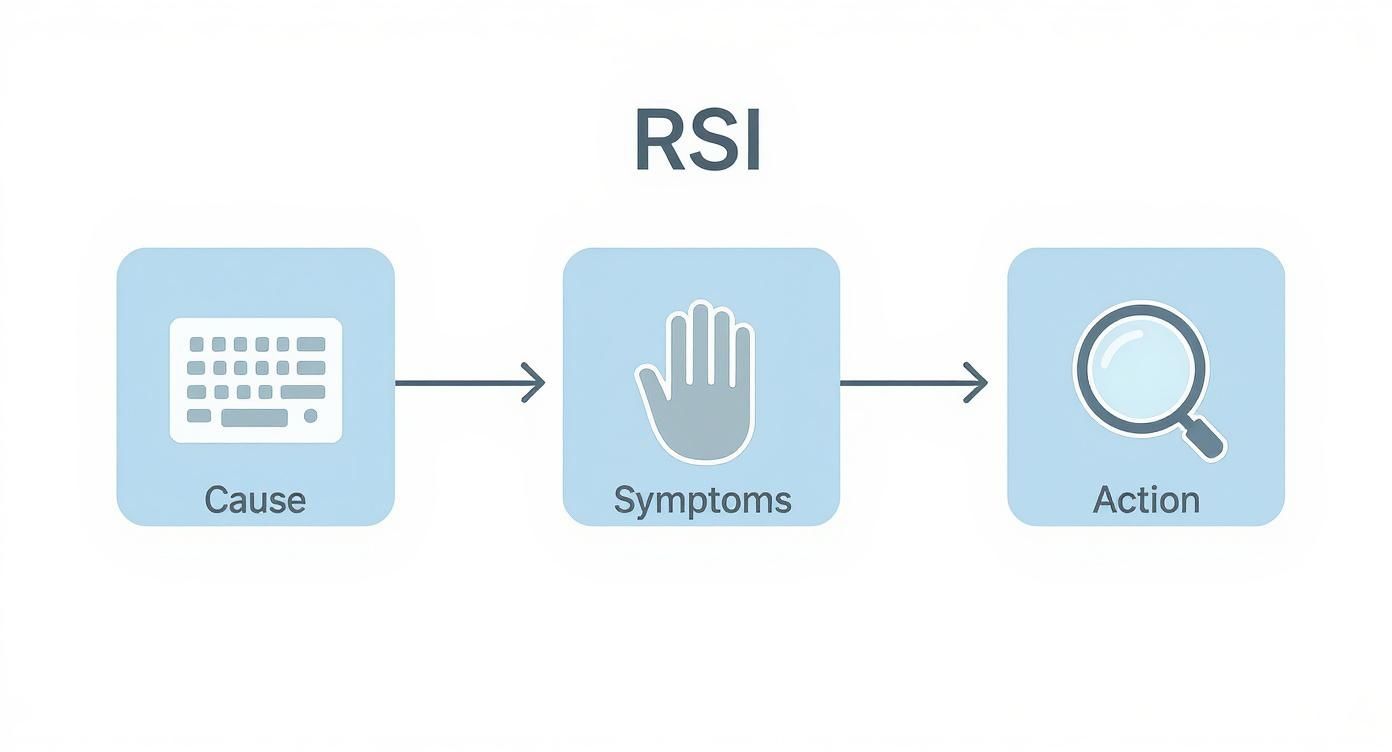
As you can see, understanding the root cause and recognising the early symptoms are what empower you to take meaningful, preventative action before a small ache becomes a major problem.
Building Your Ergonomic Foundation
Let's start with the non-negotiables. Getting these fundamentals right delivers the biggest return on your effort for preventing RSI. They’re the bedrock of a healthy workspace.
Your Chair: The Unsung Hero
Your chair is so much more than just a place to sit—it's the foundation of your entire posture for the day. Your feet should be flat on the floor with your knees at roughly a 90-degree angle, sitting level with or even slightly lower than your hips. If your feet are dangling, don't just put up with it. Grab a proper footrest or even a sturdy stack of books as a quick fix.
You also need to make sure your lower back is properly supported. A good ergonomic chair will have adjustable lumbar support built in, but if yours doesn't, a rolled-up towel or a small cushion wedged into the curve of your back works wonders. The goal is to maintain that gentle, natural "S" curve in your spine, not to force it into a rigid, straight line.
Monitor Placement for a Happy Neck
Neck strain is often the first domino to fall, leading to wider issues across your upper body. The fix is surprisingly simple: position your monitor directly in front of you, about an arm's length away.
The top of the screen should be at or just slightly below your eye level. This single adjustment prevents you from hunching over or craning your neck forward—two habits that compress nerves and strain muscles over time. This is especially crucial for laptop users. Propping your laptop on a stand (or a few books) and using a separate keyboard and mouse is non-negotiable for any long work session. For a deeper dive into this, you can explore the musculoskeletal effects of poor posture.
Refining Your Desk and Peripherals
Once your core posture is sorted, it's the smaller details that make a huge difference in warding off wrist and hand strain. These are the adjustments that directly tackle RSI at the point of action.
Your keyboard and mouse should be on the same level, positioned so your elbows can rest comfortably at your sides at about a 90-degree angle. Your wrists need to be straight, not bent up, down, or off to the sides. This is what we mean by a neutral wrist position. If you notice your wrists angling sharply to reach the keys, it might be time to consider an ergonomic keyboard or a simple wrist rest for extra support.
A common mistake I see all the time is people resting their wrists on the sharp edge of a desk. This puts direct pressure on the nerves in the carpal tunnel. Always make sure your hands and forearms are supported, creating a straight, uninterrupted line from your elbow right down to your fingertips.
Your 5-Minute Ergonomic Workstation Checklist
You don't need a heap of expensive gear to create a healthier workspace. This quick-scan checklist is designed to help you audit your current setup and make immediate, effective improvements in just a few minutes.
| Area of Focus | Optimal Setup | Quick Fix |
|---|---|---|
| Chair Height | Feet are flat on the floor; knees are level with or slightly below hips. | Use a footrest or a stack of books if your feet don't reach. |
| Monitor Position | Top of the screen is at or just below eye level, an arm's length away. | Stack books or a monitor stand under your screen to raise it. |
| Keyboard & Mouse | Positioned to keep elbows close to your body and wrists straight. | Place the keyboard on your lap temporarily to find the right height. |
| Back Support | Lower back is fully supported, maintaining the natural curve of your spine. | Place a small pillow or rolled towel in the small of your back. |
| Lighting | Light source is to the side of your screen, not behind it, to avoid glare. | Adjust blinds or move a lamp to reduce eye strain. |
Think of this checklist as your practical guide to turning any space—from a corporate office to a temporary desk on the go—into a haven that supports your body, not strains it. Making these small, consistent adjustments is one of the most powerful steps you can take in preventing RSI.
Integrating Movement Into Your Workday
An ergonomic setup is a brilliant start, but it only solves half the problem. Let's be honest, the human body just wasn't designed to stay still for eight hours a day.
Even with the perfect chair, static postures lead to muscle fatigue, reduced blood flow, and that gradual strain that slowly builds into a repetitive strain injury. The most powerful way to counter this is to weave small, consistent movements into the very fabric of your workday.

This isn’t about blocking out an hour for a gym session. It’s about embracing the power of the ‘micro-break’—brief but frequent moments of movement that reset your body, boost circulation, and keep your muscles and tendons supple. These small actions are your secret weapon in learning how to prevent repetitive strain injury before it ever takes hold.
Simple Frameworks for Consistent Movement
Getting started is much easier when you have a simple structure to follow. Think of these less as rigid rules and more as helpful prompts to pull you out of the static trap.
One of the most effective methods I've seen in office environments is the 20-20-20 rule. It was originally designed to combat digital eye strain, but its benefits extend far beyond that. The idea is simple: every 20 minutes, look at something 20 feet away for at least 20 seconds. Use this moment as your cue to also roll your shoulders, stretch your neck, or just stand up.
Another great strategy is to use a timer. Set an alarm on your phone or watch for every 50 minutes. When it goes off, that's your non-negotiable signal to get up for a few minutes. Walk to the kitchen for a glass of water, do a lap of the office, or simply stand and stretch by your desk. The task can wait; your long-term health can't.
Desk-Friendly Stretches for Targeted Relief
You don't need a yoga mat or a lot of space to give your most overworked muscles some much-needed attention. These discreet stretches can be done right at your desk, whether you're in a busy Sydney office or working from a hotel room.
For Your Hands and Wrists:
- Wrist Extensor Stretch: Extend one arm in front of you with your palm facing down. Gently use your other hand to bend the outstretched wrist downwards, holding for 15-20 seconds. You should feel a gentle stretch in your forearm.
- Finger Tendon Glides: Make a sequence of hand shapes: start with an open hand, then a hook fist, a full fist, and finally a straight fist (like you're pointing with your knuckles). This simple sequence moves the tendons through their full range of motion.
For Your Neck and Shoulders:
- Shoulder Shrugs: Simply lift your shoulders up towards your ears, hold for a few seconds, and then release them down. This is fantastic for relieving tension that builds up in your upper back and neck.
- Gentle Neck Tilts: Slowly tilt your head to one side, as if trying to touch your ear to your shoulder, until you feel a light stretch. Hold for 15 seconds, then repeat on the other side. Avoid rolling your head in full circles, as this can strain the neck vertebrae.
These movements do more than just prevent aches. By regularly contracting and releasing your muscles, you actively pump blood through the tissues. This improved blood flow delivers vital oxygen and nutrients while flushing out metabolic waste products that can contribute to inflammation and pain.
Improving circulation really is a cornerstone of musculoskeletal health. Beyond these micro-movements, understanding how to improve circulation naturally can provide broader benefits for your overall well-being and resilience against strain.
Making these small, deliberate movements a non-negotiable part of your workday transforms your desk from a place of static strain into a dynamic environment that actually supports your health.
Proactive Wellness Through Therapeutic Massage
Beyond your ergonomic setup and daily stretches, there’s a powerful, hands-on strategy for proactive wellness: therapeutic massage. While it’s often seen as a luxury, targeted massage is actually a strategic health investment, playing a crucial role in any serious plan for preventing repetitive strain injury.
It goes much deeper than just feeling good. A professional massage actively works to undo the cumulative stress that builds up in overworked tissues, day after day.
A skilled therapist can be a game-changer because they address the physiological root of RSI. They use specific techniques to release chronic muscle tension, break down those small, nagging knots or adhesions, and dramatically improve blood flow to areas that have become tight and restricted. This process restores flexibility, reduces inflammation, and gives your body the resources it needs to repair itself before a minor strain becomes a debilitating injury.
The scale of this issue in Australia really underscores the need for proactive measures like this. In the 2021-22 financial year, Australia recorded a staggering 497,300 people with work-related injuries or illnesses. Musculoskeletal disorders were the most common problem, accounting for nearly a third of all serious claims and affecting about 45,500 workers annually. You can see the full details in these work-related injury findings from the Australian Bureau of Statistics.
This data makes it clear that RSI isn't a fringe issue. It's a mainstream workplace health crisis where preventative bodywork can make a real, tangible difference.
Bringing Wellness Directly to You
One of the biggest hurdles to incorporating regular massage is, of course, time and convenience. Thankfully, modern wellness services have adapted to fit seamlessly into our busy lives. You no longer have to carve out half a day to visit a clinic; wellness can now come directly to you.
This shift has made professional bodywork more accessible than ever, turning it from an occasional treat into a sustainable part of your RSI prevention routine.
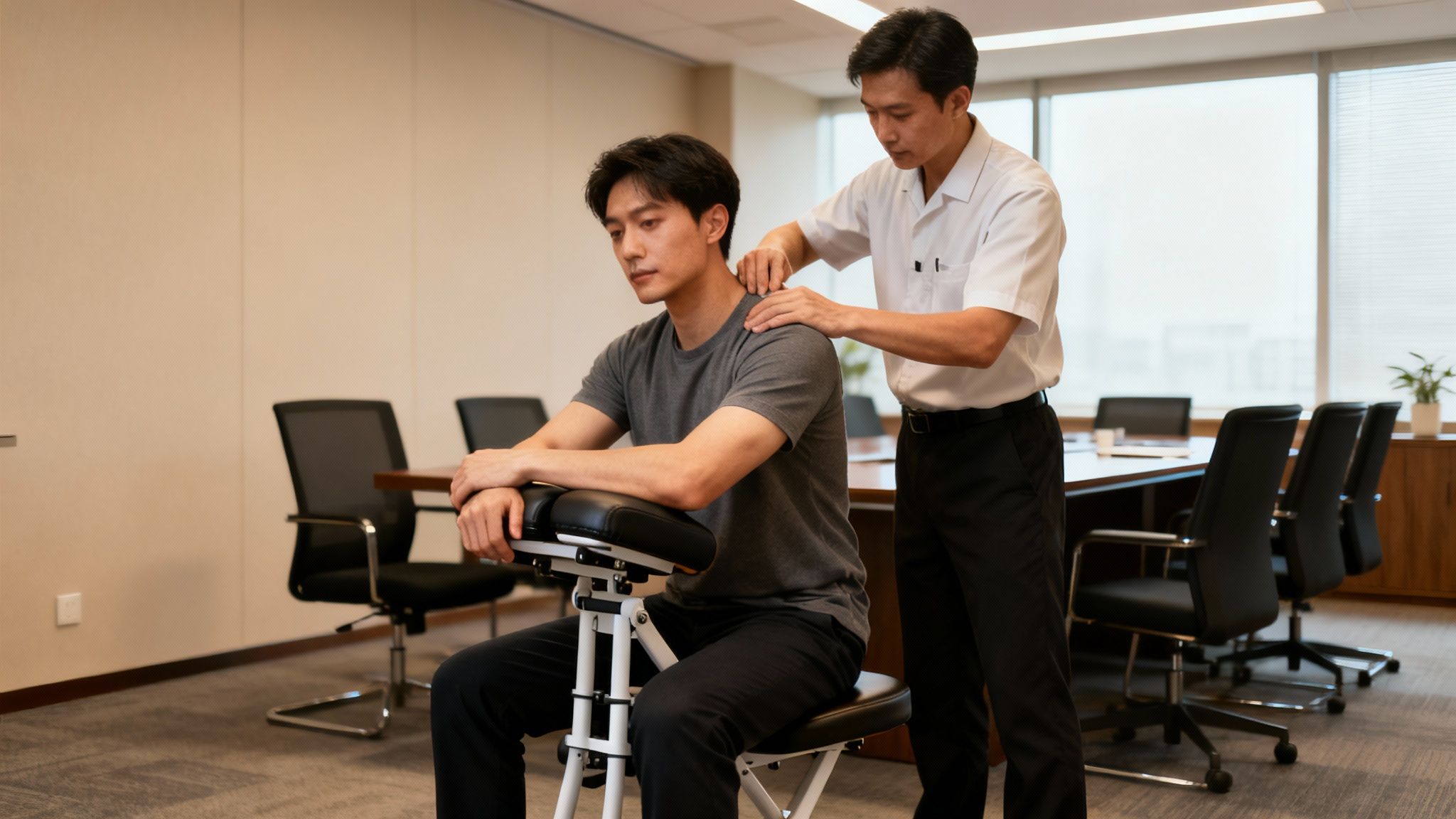
Corporate Seated Massage: Forward-thinking companies across Sydney and Melbourne are bringing wellness right into the workplace. Therapists set up an ergonomic massage chair in a quiet corner of the office, offering 15-20 minute seated massages that focus on the high-tension areas of the neck, shoulders, back, and arms. It's an incredibly effective way to break the cycle of static posture and muscle strain without disrupting the workday.
Mobile In-Home Massage: For those working from home or simply preferring the comfort of their own space, mobile massage is the perfect solution. A professional therapist arrives at your door with a proper massage table, linens, and oils, transforming your living room into a private treatment sanctuary. This removes all the stress of travel and parking, allowing you to fully relax and get the maximum benefit from the session.
Bespoke Wellness Experiences, Anywhere
The flexibility of mobile wellness extends far beyond just the home or office. It’s about receiving premium care in whatever environment best suits your lifestyle, ensuring your health routine never has to take a backseat.
Imagine this scenario: you're finalising a major deal from a hotel in Brisbane, spending long hours hunched over a laptop. Instead of letting that tension build, you can book an in-room remedial massage to work out the knots in your shoulders and release the strain in your forearms. The therapist comes to you, allowing you to de-stress and recover without ever leaving your room.
This level of personalised care can even extend to the most unique settings. For those enjoying downtime on the Gold Coast, it's entirely possible to arrange for a therapeutic massage on a yacht. A skilled therapist can come aboard to provide a restorative treatment, ensuring that even your leisure time contributes to your long-term strategy for preventing repetitive strain injury.
This adaptability is what makes professional massage such a powerful component of a modern wellness plan. It’s not just about addressing pain when it pops up; it's about consistently and conveniently investing in your body's resilience.
By integrating regular, targeted bodywork—whether in the office, at home, or even on the water—you are taking a definitive step to keep your muscles, tendons, and nerves healthy, flexible, and ready for whatever your work demands of them.
Fostering a Culture of Wellness in the Workplace
Individual effort is a great start, but when it comes to truly preventing repetitive strain injuries, it's a team sport. For the leaders, HR managers, and forward-thinking companies across Australia, building a genuinely healthy work environment is one of the smartest investments you can make.
It’s all about shifting the company culture. We need to move away from only fixing problems after they happen and start building a space where proactive, collective wellness is just part of the workday.
This means creating an environment where musculoskeletal health is a shared priority. When an employee takes a moment to stretch their wrists or walks away from their desk for five minutes, it shouldn't be seen as slacking off. It should be recognised for what it is: a smart, productive action that helps maintain focus and long-term performance.
This kind of cultural shift always starts at the top, with visible leadership and tangible support. It’s about empowering your team with the right tools, knowledge, and—most importantly—the permission to look after their physical wellbeing.
Building the Business Case for Wellness
Let's be clear: investing in wellness isn't just a fluffy perk; it’s a powerful business strategy with a very clear return. The costs that come with workplace injuries, especially the recurring ones, are huge.
In fact, Australian research highlights a staggering statistic: recurrent injuries accounted for 53.4% of all claims over a thirteen-year period, despite coming from just 26.2% of claimants. This number alone shows how critical it is to have targeted prevention programs that stop minor aches from spiralling into chronic, costly problems. You can learn more about the impact of recurrent injuries in the workplace from the research.
By proactively building a culture of wellness, you're not just preventing pain. You're directly impacting your bottom line through:
- Reduced Absenteeism: Healthier, pain-free employees simply take fewer sick days. It's that simple.
- Lower Insurance Claims: A smart approach to RSI prevention can slash the frequency and severity of workers' compensation claims.
- Enhanced Productivity: Staff who aren't distracted by nagging pain are more focused, engaged, and efficient.
- Improved Employee Retention: A company that genuinely cares for its team's wellbeing is a place people actually want to stay.
Practical Strategies for a Healthier Workplace
Making musculoskeletal health a company-wide priority means putting practical, visible initiatives in place. These are the actions that show your team their health is valued and give them the resources they need to avoid injury.
One of the most effective strategies I've seen is bringing wellness directly into the office. Corporate wellness programs, particularly those involving seated massage, are an excellent way to tackle muscle tension before it becomes a real issue. A quick 15-minute seated massage can effectively release strain in the neck, shoulders, and back—the exact areas hit hardest by desk work.
Bringing a massage therapist into your Sydney or Melbourne office for a day sends a powerful message. It tells your team you understand the physical demands of their roles and are actively investing in their recovery and comfort.
Beyond massage, think about setting up regular ergonomic assessment programs. Having a professional come in to review workstation setups and offer personalised advice not only prevents injuries but also shows a real commitment to each person's health.
Suddenly, justifying the budget for better equipment like adjustable chairs or sit-stand desks becomes much easier. It's no longer just an "expense"—it's an investment in productivity and injury prevention.
Likewise, organising workshops on posture, movement, and stretching can equip your entire team with the knowledge to protect themselves. If you're looking for ideas on how to structure an event like this, our guide on designing effective R U OK? Day massage workshops has some great insights.
Ultimately, fostering a culture of wellness is about making the healthy choice the easy choice. It’s about creating an environment where taking care of your body is a normal, encouraged, and integral part of a productive workday.
Common Questions About Preventing RSI
Navigating workplace wellness often brings up practical queries—especially around repetitive strain injury (RSI). Whether you’re an individual fine-tuning your daily routine or a manager setting up team support, these honest answers should give you clarity and confidence.
How Do I Know If It Is RSI Or Just A Minor Ache?
Muscle soreness after a big push or a new activity usually fades in a day or two. It’s the kind of ache you shrug off after a good night’s sleep.
By contrast, RSI pain is persistent. You’ll feel tingling, stiffness or aching every time you repeat the same motion. It often starts earlier in your workday and hangs around long after you’ve clocked off.
If you notice that rest no longer does the trick—and your discomfort is becoming a feature of each week—trust your instincts. Your body is signalling that this isn’t “just a niggle.”
Do I Really Need Expensive Ergonomic Gear?
Not at all. You can support a neutral posture with creative tweaks rather than a big spend. Think of it as tailoring your existing desk setup to suit you, rather than the other way around.
Here are a few simple hacks I’ve used in real offices:
- Place a stack of books or a screen riser under your monitor so your eyes sit level with the top third of the screen.
- Roll up a towel or pop a small cushion behind your lower back for extra lumbar support.
- If your feet dangle, put a strong box or ream of paper under your desk as a footrest.
The real investment is the ten minutes you spend getting these details right. That small effort pays back in reduced strain and better focus.
How Often Should I Really Be Taking Breaks?
Long lunches won’t undo hours of static work. Instead, pepper your day with micro-breaks to interrupt muscle tension before it builds up.
A handy approach is the 50/10 Rule: work for 50 minutes, then step away from your screen for 10 minutes. If that feels too rigid, aim for at least a two-minute pause every half hour. During these breaks:
- Stand up and walk around
- Stretch your wrists, shoulders and neck
- Change your posture or do a quick set of shoulder rolls
“It’s not about stopping work; it’s about making your work sustainable.”
These short pauses act like mini resets—boosting both your focus and your physical resilience.
Can Massage Really Prevent RSI Or Is It Just For Relaxation?
Massage isn’t merely a luxury; it’s proactive body maintenance. A skilled therapist uses targeted techniques to break down tight knots, improve circulation and flush out metabolic waste.
By addressing muscle tension at its source, you slow the cumulative damage that leads to RSI. That’s why on-site seated massage or mobile massage at home is fast becoming a staple in forward-thinking corporate wellness programs.
These sessions go beyond relaxation. They’re a functional strategy to keep your team moving comfortably—long before a niggle turns into downtime.
At The Royal Masseur, we believe proactive wellness is the foundation of productivity. Our mobile massage and corporate-wellness programs bring experienced therapists direct to you—whether you’re at home, a Sydney office, a Brisbane hotel or even on a Gold Coast yacht. Take the most important step in preventing RSI today by investing in your body’s resilience. Learn more and book your personalised session at https://theroyalmasseur.com.au.
[…] An actionable insight is to schedule these sessions proactively. By bringing in targeted massage, you can get on top of these symptoms and stop them from turning into chronic problems. If you're looking for practical ways to fight this specific type of workplace strain, have a look at our guide on how to prevent repetitive strain injury. […]
[…] minor, unaddressed ergonomic issues. To get a much deeper insight into this specific risk, you can learn more about how to prevent repetitive strain injury in our detailed […]