Posted on Leave a comment

What Is Therapeutic Massage and How Does It Work

Therapeutic massage is all about results. It’s a targeted treatment designed to relieve pain, sort out muscular imbalances, and get your body functioning properly again. This isn't your average relaxation massage; it’s a focused session with a clear physical goal, making it an incredibly powerful and actionable tool for your overall wellbeing, wherever you are.

Understanding Therapeutic Massage Beyond Relaxation
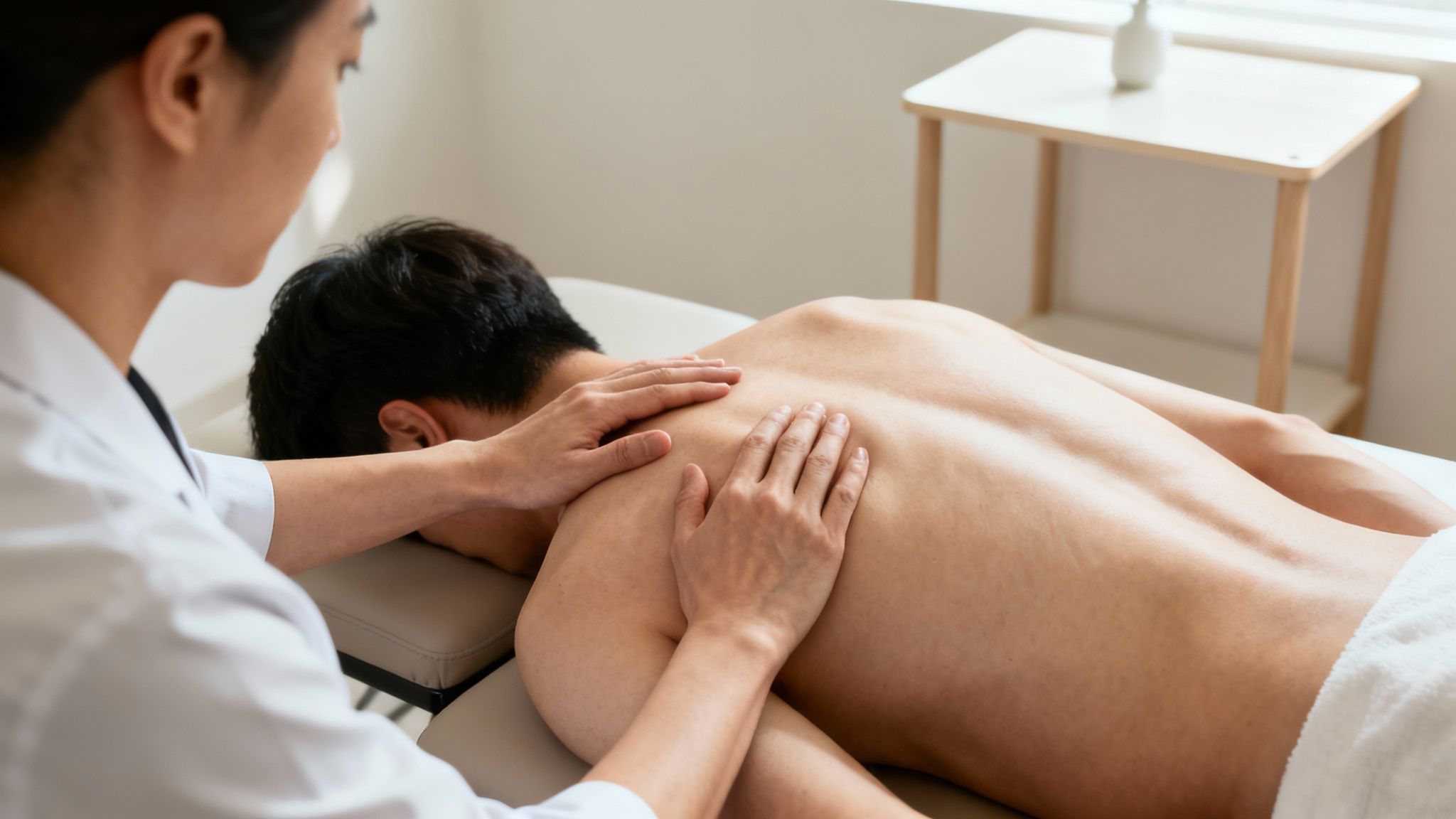
A person receiving a therapeutic massage on their shoulder in a calm setting.

Think about the difference between a casual stroll in the park and a session with a personal trainer. Both involve moving your body, but one is purely for gentle enjoyment, while the other is carefully structured to hit a specific fitness target. That’s the perfect way to think about therapeutic massage.

A relaxation massage is designed to soothe your nervous system and give you a general sense of calm. A therapeutic session, on the other hand, is a strategic intervention. It’s an outcome-driven treatment that gets to work on specific problems within your body’s soft tissues—your muscles, tendons, and ligaments.

This approach takes things beyond simple pampering and moves into the realm of structured physical care. The main goal isn't just to make you feel good for an hour; it's to create lasting changes that genuinely improve your quality of life.

A Focus on Specific Wellness Goals

What truly makes a massage "therapeutic" is its clear, defined purpose. Before your therapist’s hands even get to work, you’ll have a chat about what you want to achieve. This goal-oriented method makes it highly effective for a whole range of modern-day aches and pains.

Just look at the demands of modern life. Long hours hunched over a desk often lead to chronic neck and shoulder pain, a complaint so many Australians know all too well. An actionable insight is to book a therapeutic massage delivered right to your office. It can directly target those strained muscles, helping to improve your posture and reduce the risk of repetitive strain injuries.

It's the same if you’re recovering from a sports injury at home or managing a chronic condition. A mobile therapist can bring that specialised care right to your door. This convenience alone removes the stress of travel, letting your body put all its energy into healing. For those wanting the ultimate restorative experience, a session in a private hotel room or even on a yacht creates an environment of total tranquillity, amplifying the treatment's benefits.

A therapeutic massage is less about the setting and more about the intent. It applies professional, evidence-based techniques to achieve specific wellness goals, wherever you are.

The treatment is incredibly adaptable. While it’s quite different from general relaxation techniques, you can learn more about how various styles stack up by reading our complete guide to Swedish relaxation massage. Understanding this distinction helps you pick the right service for your needs, ensuring you book a session that’s perfectly in tune with your wellness goals.

The Evolution of Therapeutic Massage in Australia

Therapeutic massage might feel like a very modern solution, perfectly designed for our hectic lives. But the truth is, its core principles are anything but new. This is a discipline that's been tested and refined for millennia, with deep historical roots and a solid, evidence-based foundation. Its journey from an ancient healing art to a respected profession within Australia’s healthcare system is a real testament to just how effective it is.

Knowing this history helps build a sense of trust. It shows that the techniques used today, whether in a high-rise office or a quiet hotel room, aren’t just passing fads. They’re part of a legitimate field dedicated to physical wellbeing—a practice that has earned its place by getting real results, time and time again.

The simple idea of using touch to heal is ancient. Historical records show therapeutic massage has been around for about 2,500 years, with some evidence even pointing back to 2500 BCE. Here in Australia, it was first introduced as a complementary medical treatment in the late 1800s and early 1900s. Its role became much more official during the 20th century, especially during World War One and Two, when it was a key part of soldier rehabilitation programs. You can discover more about its early history and its journey into Australian healthcare.

From Battlefields to Boardrooms

Using massage to help soldiers recover was a massive turning point. It proved, on a large scale, the practice’s profound ability to restore function, manage pain, and speed up recovery from serious physical trauma. This wartime application offered powerful, real-world proof of its medical value, helping to shift how people saw it—from a simple comfort measure to a serious therapeutic tool.

After the wars, the profession just kept maturing. The mid-to-late 20th century saw the establishment of professional associations and formal training standards right across Australia. This was a critical step in cementing its credibility, making sure practitioners had a deep understanding of anatomy, physiology, and pathology.

Therapeutic massage moved from the fringes of complementary medicine into the mainstream of allied health, backed by scientific validation and a commitment to professional excellence.

This professionalisation meant that techniques like deep tissue massage, trigger point therapy, and myofascial release were no longer just intuitive practices. They became structured treatments, all based on a clinical understanding of how our soft tissues respond to targeted manipulation.

Therapeutic Massage in Modern Australia

Today, therapeutic massage is a core part of the Australian wellness landscape. It’s recognised for its ability to tackle the specific physical strains of modern life—from the “tech neck” that’s so common among office workers to the repetitive strain injuries we see in athletes.

And its evolution is still going, especially in how it’s delivered. The rise of premium mobile services has made expert care more accessible than ever, bringing targeted relief directly to where it’s needed most:

  • In the office: Corporate wellness programs now use seated massage to combat workplace stress and boost productivity.
  • At home: People managing chronic pain or recovering from an injury can now get treatment in a comfortable, private setting.
  • In luxury settings: High-end hotels and even private yachts now offer therapeutic sessions, providing the ultimate convenience and recovery for travellers and professionals.

This journey from an ancient tradition to modern, mobile healthcare really solidifies its status. It’s a powerful and legitimate tool for looking after your physical wellbeing, no matter the environment.

When most people hear the word "massage," they picture a tranquil spa day, all fluffy robes and cucumber water, designed for pure, blissful escape. While that's a fantastic experience, it's only one side of the story. The real game-changer is the intent behind the treatment, and understanding this difference is the secret to getting the results you're actually looking for.

Choosing between a therapeutic and a relaxation massage is a bit like deciding between a gentle yoga class and a targeted physiotherapy session. One is all about achieving a state of general calm and disconnecting from a stressful week; the other is about diagnosing and fixing a specific problem, like reconnecting a painful shoulder to its proper function. Both are incredibly valuable, but they serve entirely different masters.

This distinction is crucial whether you're looking to unwind in a hotel room, boost team focus with an office wellness program, or find deep restoration on a yacht. Knowing what you want to achieve ensures the session you book is perfectly aligned with your body's needs.

The Core Difference Is Intent

At its heart, the main thing separating these two styles is the goal of the session. A relaxation massage, which is often a Swedish massage, uses long, flowing strokes, gentle kneading, and rhythmic tapping. The primary objective is to soothe your nervous system, ease mild muscle tension, and leave you feeling peaceful and refreshed. It’s a full-body reset for your mind.

A therapeutic massage, on the other hand, always starts with a specific physical problem to solve. It’s a targeted, outcome-focused treatment that uses a whole toolbox of techniques to get to the root cause of pain, restore mobility, or correct muscular imbalances. It's less about a generalised feeling of calm and much more about achieving a measurable improvement in how your body works.

This little decision tree simplifies the choice right down to its most basic question.
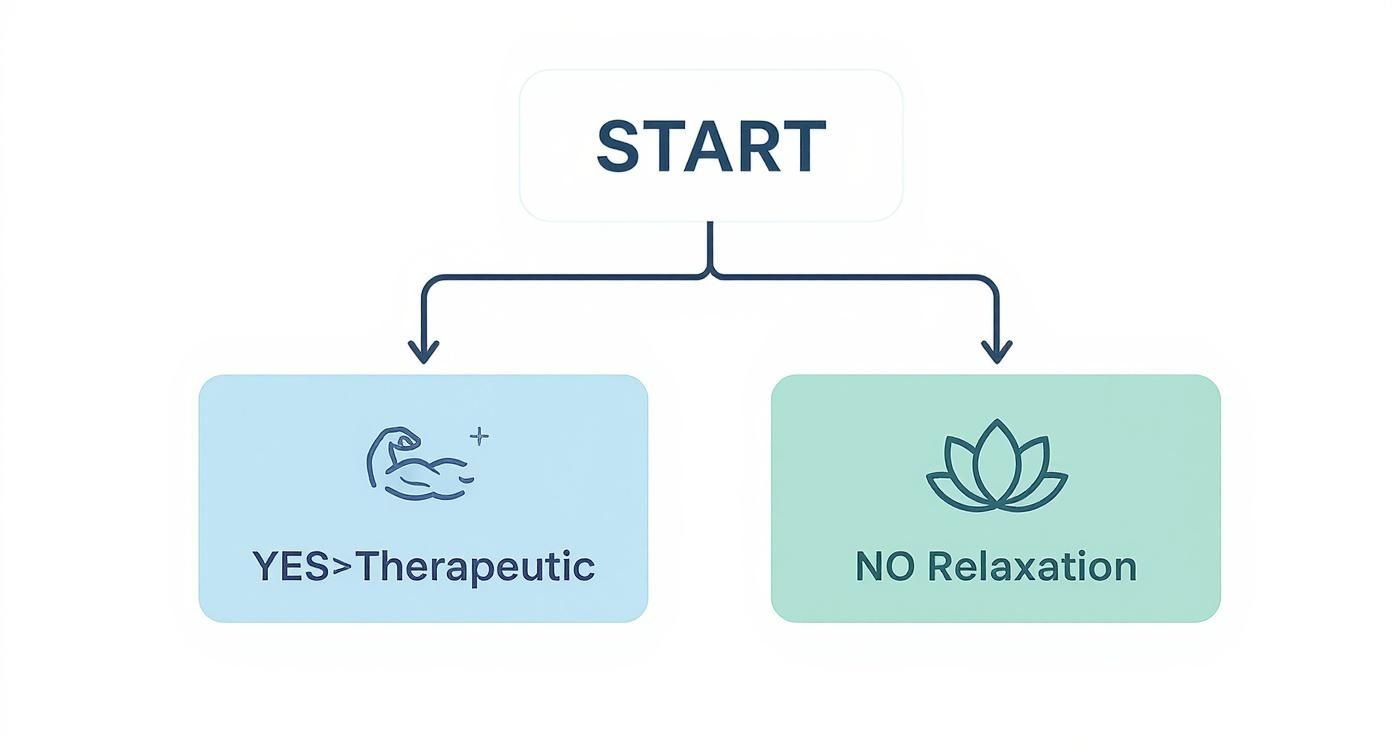
Flowchart illustrating a 'START' point leading to 'YES>Therapeutic' with a muscle icon or 'NO Relaxation' with a lotus icon.

As you can see, if pain or a specific physical issue is your main driver, a therapeutic approach is the most direct path to finding real relief.

Therapeutic vs Relaxation Massage Which Is Right for You?

To make the choice even clearer, let's break down the key differences side-by-side. This comparison shows just how much the session's ultimate goal shapes every single part of the experience.

AspectTherapeutic MassageRelaxation (Swedish) Massage
Primary GoalTo resolve a specific physical issue like chronic pain, limited mobility, or injury recovery.To reduce stress, promote general relaxation, and induce a sense of overall wellbeing.
Techniques UsedEmploys a diverse range of techniques, including deep tissue, trigger point therapy, and myofascial release.Primarily uses long, gliding strokes (effleurage), kneading (petrissage), and rhythmic tapping (tapotement).
Pressure AppliedVaries from light to deep and intense, depending on the issue being treated and your comfort level.Typically uses light to medium pressure, focused on creating a soothing, comfortable experience.
Client CommunicationInvolves active and ongoing dialogue. The therapist will ask for feedback on pressure and sensation to guide the treatment effectively.Generally involves minimal talking to allow you to fully disconnect and relax.
Area of FocusConcentrates on specific areas of the body that are causing pain or dysfunction.Usually a full-body treatment designed to address all major muscle groups equally.
Ideal ScenarioYou're dealing with a recurring stiff neck from your desk job or recovering from a sports-related strain.You’ve had a stressful week at work and need to mentally switch off and de-stress your body.

The most important thing to remember is that therapeutic massage is a partnership. It needs your active participation and communication to pinpoint problem areas and work towards a specific, functional outcome.

Ultimately, both styles of massage are powerful tools for managing your health. By understanding their distinct goals and methods, you can confidently choose the right treatment to meet your needs, ensuring every session—whether at home, in the office, or on the water—delivers exactly what your body and mind are crying out for.

Real-World Benefits of Therapeutic Massage for Your Lifestyle

We all know massage can help with pain, but the real power of therapeutic massage is how it delivers specific, targeted results that slot perfectly into your modern life. It's a practical fix for today's problems, offering tangible relief right where you need it, whether that's in a busy office or the quiet of your own home.

This is about getting past vague wellness promises and seeing genuine, real-world improvements. Instead of just "feeling less pain," imagine finally sorting out that nagging "tech neck" from a week of video calls, or easing the lower back ache that comes with constant travel. Therapeutic massage uses precise techniques to solve these exact issues.

Elevating Wellness in the Office

The modern workplace can be a real battleground for our bodies. Long hours hunched over a screen lead to rounded shoulders, a forward head posture, and chronic tension that settles deep in the neck and upper back. It's a huge issue—Safe Work Australia flags work-related musculoskeletal disorders as a major problem affecting thousands of employees every year.

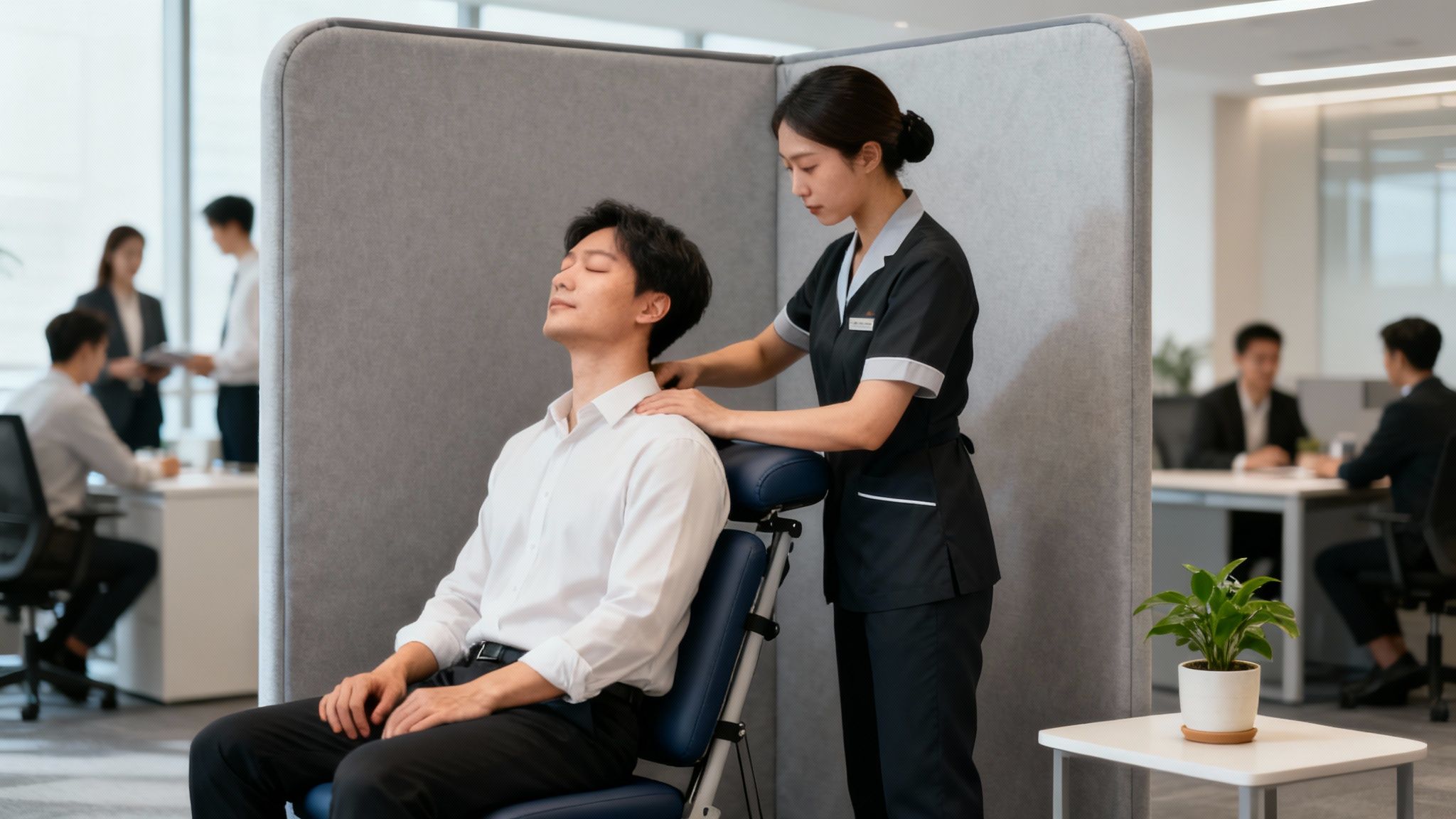
This is exactly where corporate wellness massage programs make an immediate, noticeable difference. A skilled therapist can perform targeted chair massages right in the office, zeroing in on the exact muscle groups screaming for relief after a day at the desk. Here's an actionable insight: implementing a regular office massage program is a proactive way to combat these physical strains before they become chronic issues.

  • Beating Burnout: Regular sessions are a powerful circuit-breaker for stress, helping to lower cortisol levels and head off the mental and physical exhaustion that leads to burnout.
  • Sharpening Team Focus: When physical discomfort isn't a constant distraction, employees can concentrate better, which means a big boost in productivity and fewer mistakes.
  • Cutting Down on Sick Days: Proactively tackling musculoskeletal strain helps reduce the frequency of work-related pain, contributing to a healthier and more present team.

Finding Your Sanctuary at Home

For most of us, home is the ultimate place to relax and recover. Mobile therapeutic massage brings professional care directly into this sanctuary, which is a game-changer for anyone dealing with chronic conditions, recovering from an injury, or simply trying to manage a hectic schedule. No fighting traffic, no rushing to an appointment—the healing comes right to you.

This convenience is especially vital for new mothers navigating postnatal recovery or for individuals with mobility challenges. It simply removes the barriers to getting consistent care, which is often the secret to achieving lasting results. Our guide on remedial massage therapy goes deeper into how these focused treatments are adapted for your specific needs, even in a home environment. A session tailored to you, at home, ensures your body gets the focused attention it needs to heal properly.

The real beauty of at-home therapeutic massage is its ability to weave professional care into your personal space. It allows for a deeper state of relaxation and more effective recovery, without any of the added stress of getting to a clinic.

The Ultimate Recuperation in Premium Settings

Sometimes, the environment you're in is a massive part of the healing process. For those chasing the absolute highest level of recuperation, getting a therapeutic massage in a luxury setting—like a hotel room or even on a private yacht—can seriously amplify the benefits.

Picture this: you've just stepped off a long-haul flight, and a therapist arrives at your hotel to work out all that travel-induced stiffness. Or after a day out on the water, a targeted session on the deck of a yacht helps your muscles recover while you're surrounded by total tranquillity.

These premium experiences merge expert therapeutic techniques with an environment built for ultimate relaxation. This synergy doesn't just feel good; it accelerates physical recovery and delivers a mental reset that's hard to find anywhere else. It transforms a simple treatment into a truly restorative event, helping you bounce back faster and feel profoundly refreshed. By connecting the power of touch to your immediate surroundings, therapeutic massage becomes a practical, powerful tool for boosting your wellbeing, no matter what your lifestyle looks like.

What to Expect During Your First Session

Booking your first therapeutic massage can feel a bit like stepping into the unknown. You know you need relief, but you might not be sure exactly how the session will unfold. The great news is that the whole experience is a collaboration, designed entirely around your comfort, safety, and specific wellness goals.
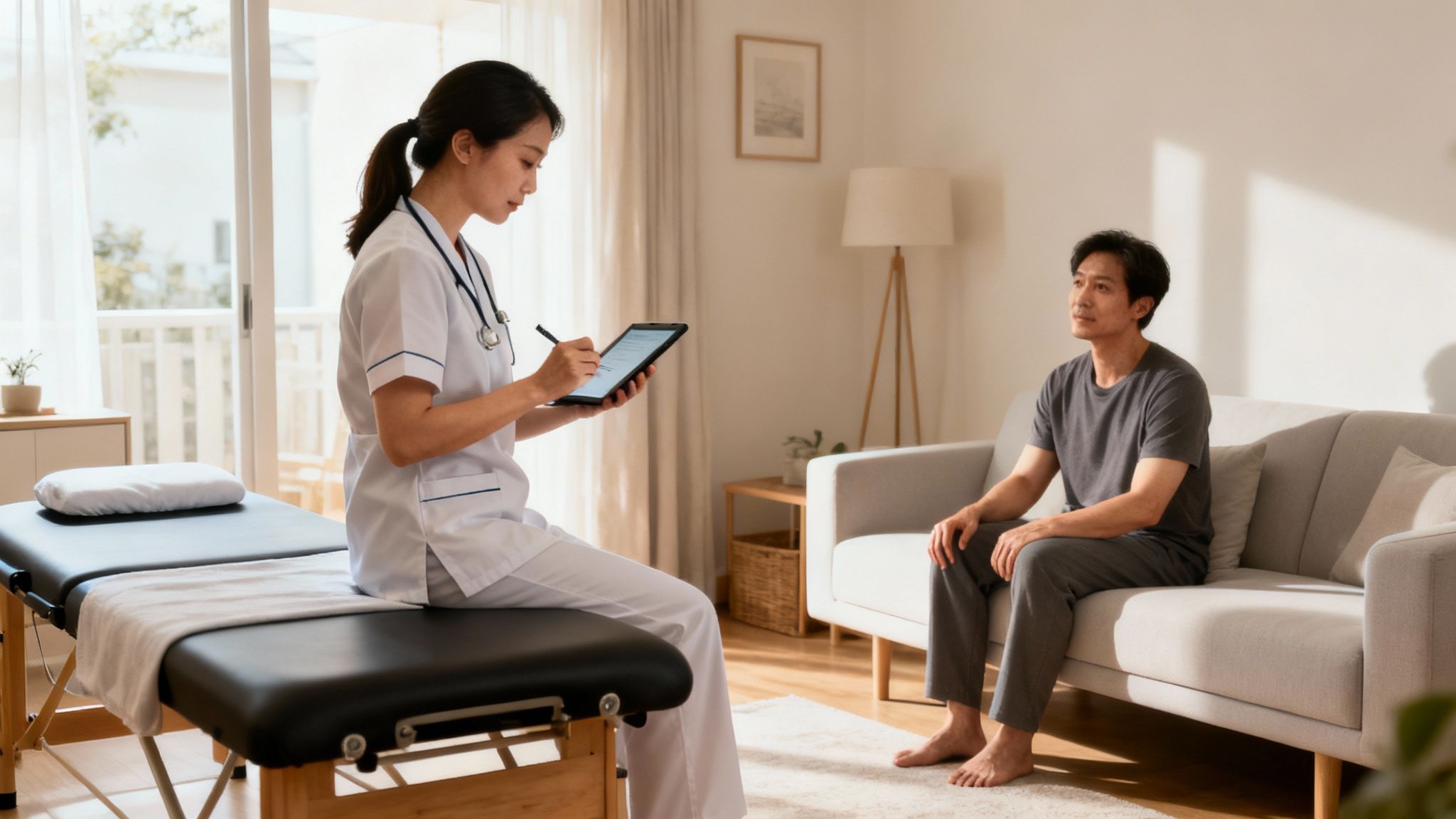
A healthcare professional consults with a male patient, taking notes on a tablet during a visit.

Whether your therapist is setting up in a corporate boardroom, your living room, or a hotel suite, the core structure of the session stays consistent. It’s all about creating a personalised treatment plan that actually works for you. Let’s walk through what you can expect, from start to finish.

The Initial Consultation

Every single therapeutic session begins with a conversation. This isn't just small talk; it's a vital part of the treatment where your therapist gets a proper understanding of your body and what you want to achieve.

You'll chat about your health history, any current injuries, and the specific areas causing you pain or discomfort. This is your time to be open and detailed. Are you dealing with stubborn neck tension from long hours at the computer? Or maybe lower back pain from a recent flight? This information helps the therapist build a mental map of your needs.

Your session is a two-way street. The more information you provide about your goals and comfort levels, the more effective and targeted your therapeutic massage will be.

This consultation is the foundation upon which a successful treatment is built, ensuring the session is tailored to you from the very first moment. It’s what turns a standard massage into a truly therapeutic experience.

The Treatment and Communication

Once the plan is clear, the hands-on portion begins. The environment will be adapted to your location, of course. In a corporate setting, this might be a specialised massage chair designed for targeted neck and shoulder work. In the privacy of your home, yacht, or hotel room, your therapist will set up a professional massage table, complete with fresh, clean linens.

Throughout the session, communication is absolutely key. Your therapist will check in with you about the pressure they are applying, and it’s essential to provide feedback. What feels like effective pressure to one person might be far too intense for another.

Remember, a therapeutic massage can sometimes involve a sensation of "good pain" as the therapist works on tight knots, but it should never be sharply or unbearably painful. You are always in control of the session.

After the massage, your therapist will likely offer some post-session advice. This might include:

  • Stretches: Simple movements to maintain mobility in the areas that were just worked on.
  • Hydration: Drinking plenty of water is crucial to help flush out metabolic waste released from your muscles during the treatment.
  • Heat or Cold Therapy: Recommendations for using a heat pack or ice to soothe any residual tenderness.

This aftercare advice is designed to extend the benefits of your session long after the therapist has packed up, helping you feel empowered and confident in managing your own wellbeing.

How to Find a Qualified Massage Therapist in Australia

The true magic of a therapeutic massage isn't just in the techniques themselves; it flows from the skill, knowledge, and intuition of the person providing the treatment. In other words, the effectiveness of your session hinges entirely on the quality of your therapist.

Finding a properly qualified professional in Australia means looking beyond flashy websites and knowing what credentials actually matter. Investing a little time upfront to vet your therapist is the single most important step you can take to ensure you receive care that is safe, effective, and genuinely therapeutic. It’s what allows you to book with confidence, whether you need relief at home, in the office, or at your hotel.

Checking Credentials and Qualifications

Here in Australia, the massage industry has clear benchmarks for professional practice. When you’re on the hunt for a therapist, the first thing to check is their formal education. A Diploma of Remedial Massage is the gold standard, as it proves they’ve had comprehensive training in anatomy, physiology, and advanced assessment techniques.

Beyond their diploma, membership in a professional association is a massive green flag. These organisations don't just hand out memberships; they require their therapists to hold the right qualifications, maintain current first aid certifications, and be fully insured. It’s a strong sign of a therapist’s commitment to high standards.

Key Australian associations to look for include:

  • Massage & Myotherapy Australia (MMA): One of the country's leading and most respected professional bodies.
  • Association of Massage Therapists (AMT): Another top-tier organisation that holds its members to rigorous professional standards.

When a therapist is affiliated with one of these bodies, you can feel confident you're dealing with a true professional.

Practical Tips for Vetting a Therapist

Once you've got a shortlist, it's time to dig a little deeper. The demand for quality massage in Australia has skyrocketed, with employment in the sector jumping by 16.8 percent in the decade leading up to 2019. But with only 29.9% of practitioners working full-time, the field is filled with a mix of experience levels. You can read more on these trends in a government submission on the Australian migration system.

So, how do you find the best of the best? Start by reading online reviews and testimonials. What are past clients saying about their experience, the therapist’s professionalism, and the results they got?

Don't be shy about asking questions before you book, either. A great therapist will be more than happy to talk about their qualifications, their experience with your specific issue, and what a typical session with them looks like.

Using a reputable mobile massage service like The Royal Masseur gives you a huge advantage here. We do all the heavy lifting for you by pre-screening every single therapist on our team. We verify their qualifications, check their insurance, and confirm their professional memberships. This process guarantees you receive care from a vetted, high-calibre professional every single time.

Ultimately, finding a skilled practitioner is about making sure your investment in your wellbeing actually pays off. For more guidance on finding a pro, our article on locating the best massage therapists near you offers extra tips to make your search easier. Taking these simple steps ensures the hands you're in are both skilled and trustworthy.

Got Questions About Therapeutic Massage? We’ve Got Answers.

It’s completely normal to have a few questions before you dive into something new for your wellness routine. Whether you’re thinking about a session for your office, at home, or even in a luxury hotel room, getting clear answers helps you book with total confidence.

Let’s tackle some of the most common queries we hear.

How Often Should I Get a Therapeutic Massage?

Honestly, there’s no single magic number. The right frequency really comes down to your specific goals and what your body is telling you. It’s all about creating a schedule that’s tailored to your situation.

If you're dealing with an acute issue, like recovering from a sports injury or a sudden back pain flare-up, your therapist might suggest weekly sessions for a short burst to really accelerate the healing. For managing chronic conditions or as part of an ongoing corporate wellness program, fortnightly or monthly appointments are often the sweet spot for keeping tension under control. The best approach is always to chat with your therapist and create a personalised plan based on how your body responds.

Is Therapeutic Massage Supposed to Hurt?

You should expect to feel effective, focused pressure, but you should never be in sharp or unbearable pain. Some people describe the sensation during techniques like trigger point therapy as a “good pain”—that satisfying intensity you feel when a therapist is working on a stubborn knot that desperately needs to release.

The most important thing to remember is this: you are always in control of the session. Open and honest communication with your therapist is key. It ensures the pressure stays within your comfort zone while still being effective. Your comfort and safety are always the top priorities.

What’s the Best Way to Prepare for a Session?

A little preparation goes a long way and can make a huge difference to your results. To get the most out of your treatment, whether it’s at home or on a yacht, there are just a few simple things you can do.

First, make sure you’re well-hydrated by drinking water throughout the day leading up to your appointment. It also helps to have a clear idea of any specific issues or tight spots you want to focus on. Most importantly, just be ready to chat openly with your therapist about your goals and comfort levels.

What Should I Do After My Massage?

Aftercare is just as crucial as the massage itself for locking in the benefits. The first thing to do right after your session is drink plenty of water. This helps your body flush out any metabolic waste that’s been released from your muscles.

It's also a great idea to skip any strenuous exercise, heavy meals, or alcohol for several hours afterwards. Just give your body some time to rest and process the treatment. If you feel any lingering muscle tenderness, a warm bath with Epsom salts can work wonders to soothe it and extend that feeling of deep relief.


Ready to experience the targeted benefits of professional care in your own space? The Royal Masseur brings five-star therapeutic massage and wellness services directly to your home, hotel, or office. Book your session today and discover a new level of wellbeing.
Posted on Leave a comment

Your Guide to the Perfect Massage Gift Certificate

A massage gift certificate is more than just a piece of paper or a digital code. It’s a tangible invitation for someone to press pause on their hectic schedule and genuinely prioritise their wellbeing. It stands out as a thoughtful, incredibly versatile gift that offers a real escape, with benefits that last long after the massage itself has finished.

The Ultimate Gift of Wellness and Experience

In a world overflowing with possessions, giving an experience makes a far more meaningful impact. A massage gift certificate is the perfect answer for almost any occasion—a birthday, anniversary, a corporate reward for a job well done, or just a simple way to show someone you truly care.

It’s a gesture that clearly says, “You deserve this break.”

This kind of gift is ideal for everyone, from a stressed-out executive in a high-rise office to a new parent who desperately needs a quiet moment at home. It bypasses the guesswork of finding the right size or colour and instead, offers a guaranteed opportunity for pure rejuvenation.

Why Experiences Trump Things

Gifting an experience like a professional massage offers something that material items simply can't match. It’s dedicated time for the recipient to disconnect, de-stress, and focus completely on their own health. This focus on wellness is something more and more Australians are actively seeking.

The shift towards valuing experiences over objects is a powerful one. A massage certificate doesn't just provide a service; it gives a memory, a feeling of being cared for, and a much-needed pause in a busy life.

You can see this shift in the growing demand for wellness services right here in Australia. The health and wellness spa industry is on track to hit AUD 624 million by 2025, driven largely by a greater awareness of self-care and a desire for premium relaxation experiences. This shows just how perfectly a massage gift certificate aligns with modern values. Learn more about Australian wellness industry trends.

A Flexible Gift for Any Setting

One of the best things about a mobile massage gift is its sheer adaptability. The relaxation isn't confined to a spa. A professional therapist can create a tranquil, five-star environment almost anywhere.

  • At Home: Transforming a living room into a private sanctuary for ultimate comfort.
  • In the Office: Providing a much-needed wellness break to combat workplace stress and boost team morale.
  • In a Hotel Room: Adding a touch of luxury and convenience for travellers.
  • On a Yacht: Offering an exclusive wellness experience surrounded by serene waters.

This incredible flexibility ensures the gift is not just thoughtful but also practical, fitting seamlessly into the recipient's life, wherever they happen to be.

How to Choose and Purchase the Right Massage Certificate

Ready to give the gift of pure relaxation? Fantastic choice. Picking out the perfect massage gift certificate is a straightforward process once you know what you’re looking for. It all starts with thinking about the person you're buying for.

What’s their lifestyle like? Are they an athlete constantly dealing with sore muscles? A busy professional who spends too much time hunched over a laptop? Or maybe just someone who truly deserves a moment of absolute calm. Thinking about their specific needs is the key to matching them with an experience that feels personal and genuinely beneficial.

Matching the Massage to the Person

Every person's path to wellness is different, which makes your choice of massage style an important part of the gift. A deep tissue or remedial massage is a game-changer for someone with specific aches and pains, while a gentle relaxation massage can be the mental and physical reset they've been craving.

Here’s how you can tailor the experience, whether they’re at home, in the office, or even on a yacht.

  • For the Stressed Executive: Think relaxation or aromatherapy massage. It's the perfect antidote to a brutal work week and can melt away tension right in their office or hotel room, getting them recharged between meetings.
  • For the Fitness Enthusiast: A sports or remedial massage is the way to go. It’s designed to target muscle recovery and boost mobility, which can make a huge difference to their training.
  • For the New Parent: A gentle, restorative massage delivered right to their home is more than a gift; it’s a rare chance for some much-needed self-care without the stress of leaving the house.
  • For a Special Occasion: A luxurious couples massage turns a great gift into a shared, memorable experience. It’s perfect for an anniversary or any big celebration.

Getting these details right ensures your gift really hits the mark. If you want to dive deeper, our guide on choosing a top-rated massage therapist in Sydney is packed with tips to help you find the right skills for your recipient's needs.

For a clearer picture, here’s a quick comparison to help you nail the perfect choice.

Choosing the Right Massage Type for Your Gift

A comparison of popular massage styles to help you select the perfect experience for your recipient's wellness needs.

Massage TypeBest ForExperience LevelKey Benefit
RelaxationThe chronically stressed, first-timers, or anyone needing a mental break.Gentle & SoothingCalms the nervous system and provides an immediate sense of peace.
RemedialAnyone with specific aches, chronic pain, or postural issues from work.Targeted & TherapeuticAddresses the root cause of pain for long-term relief and improved function.
SportsAthletes, gym-goers, and active individuals needing to boost performance.Focused & IntenseSpeeds up muscle recovery, prevents injury, and enhances flexibility.
CouplesAnniversaries, special celebrations, or partners needing to reconnect.Shared & LuxuriousCreates a shared memory and allows two people to unwind together.

This table should make it easy to see which style aligns best with the person you have in mind, ensuring the gift is both thoughtful and effective.

A Simple and Secure Purchase Process

Once you’ve got the perfect experience in mind, buying the certificate online is designed to be completely straightforward and secure. You have two great options for delivery, depending on the situation.

An e-voucher is your saviour for any last-minute gifts, as it lands in their inbox instantly. If you want something a bit more special, a beautifully presented physical certificate sent by post adds a tangible, elegant touch to your thoughtful gesture.

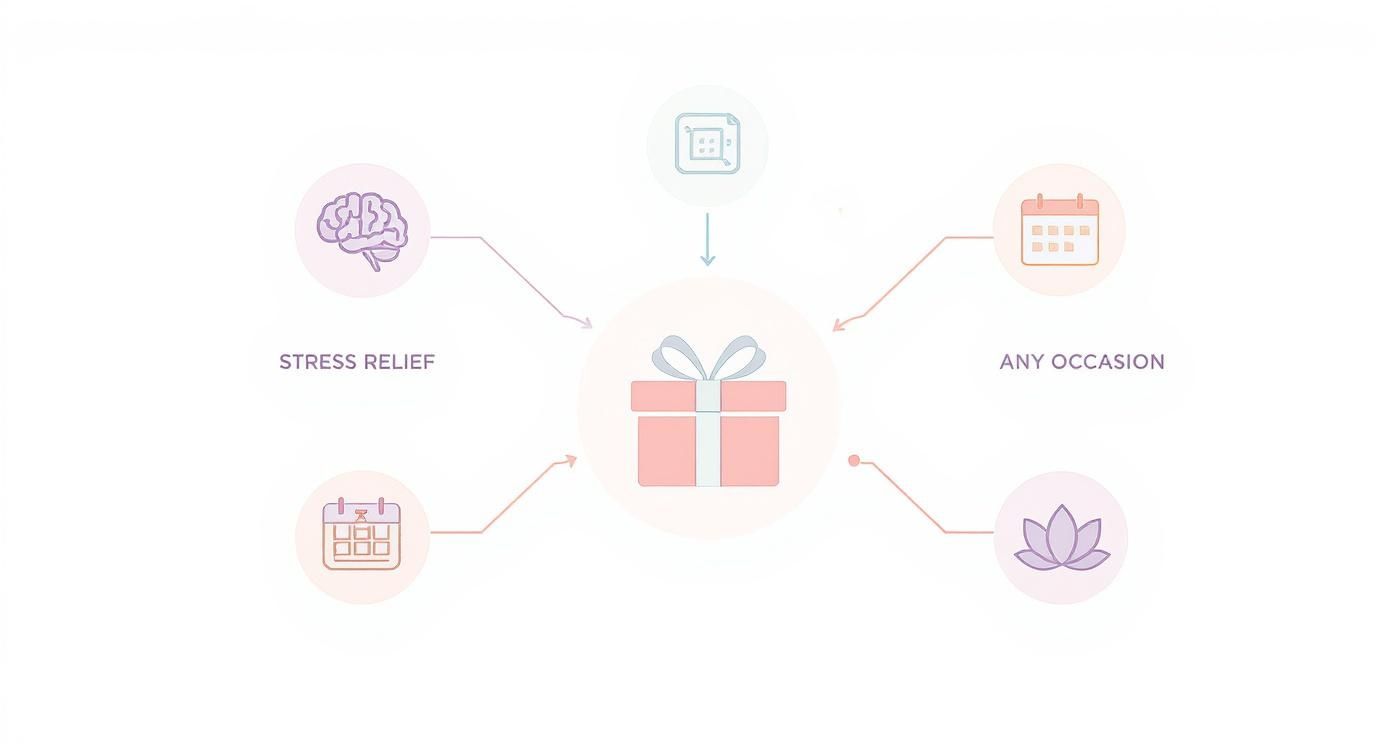
This diagram really captures the essence of what you're giving—not just a massage, but a powerful tool for stress relief and wellness.

Diagram illustrates a gift box surrounded by icons representing stress relief, gift certificates, and various occasions.

As the visual shows, a single gift can deliver so many powerful benefits, making it a versatile and meaningful choice for almost any occasion. During the online checkout, you’ll just need to pop in the recipient's details, select the massage duration, and add a personal message to make the gift complete. It’s that easy.

Elevating Corporate Gifting with Wellness

It's time to move beyond the usual box of chocolates or generic gift cards. A massage gift certificate is a modern, meaningful way for Australian businesses to show they genuinely appreciate their employees and clients. It’s a direct investment in their wellbeing, which speaks volumes about a corporate culture that values health and work-life balance.

This kind of gift sends a clear message: you care about your people on a human level. It’s a powerful tool to combat workplace stress, a massive problem that costs the Australian economy an estimated $14.2 billion every year in lost productivity. Giving your staff a tangible way to de-stress isn't just a nice perk; it’s a smart business move.

Fostering Loyalty and Boosting Productivity

When employees feel properly valued, their engagement and loyalty skyrocket. Gifting a wellness experience like a professional massage is a high-impact reward that genuinely boosts morale and helps build a positive workplace. It’s a world away from an impersonal cash bonus, creating a memorable experience that directly helps reduce stress and sharpen focus.

The benefits go far beyond just feeling good. A relaxed and rejuvenated team is a productive one. When you integrate wellness rewards, you'll likely see:

  • Reduced absenteeism by tackling stress and burnout before they become serious issues.
  • Increased focus and creativity as employees come back to work feeling mentally refreshed.
  • Stronger team cohesion when wellness becomes a visible, valued part of the company culture.
  • Enhanced employee retention, because people are far more likely to stick with an employer that invests in their health.

A Smart Investment in Your Team

The Australian massage therapy sector is growing fast, with a projected compound annual growth rate of 7% or higher from 2025 through 2035. This growth reflects a huge public demand for premium wellness services, making a massage gift certificate a highly desirable reward. Discover more insights about the massage therapy market.

Investing in employee wellness is no longer an optional extra—it’s a core component of a successful business strategy. A massage certificate is a simple, effective way to show your team that their health is a priority, leading to a happier, more resilient workforce.

For businesses looking to make a real impact, bulk purchasing options for a massage gift certificate make managing rewards programs easy. You can use them to celebrate big milestones, acknowledge outstanding performance, or as a thoughtful client gift that strengthens professional relationships. It's a premium perk that resonates deeply and shows you're a forward-thinking organisation. To see how this fits into a broader strategy, check out our guide on workplace wellness program ideas.

The Luxury of a Massage Anywhere You Are

Imagine the pure convenience of a five-star wellness experience arriving right at your doorstep. A massage gift certificate for a mobile service isn't just a present; it's the key to unlocking total relaxation without the hassle of travel, finding a park, or trying to squeeze it into a packed schedule. This is the modern way to do self-care—a professional, spa-quality massage that fits perfectly into anyone’s day, wherever they might be.

The real magic of this gift lies in its incredible versatility. It has the power to transform any space into a private sanctuary of calm. A skilled therapist brings everything needed—a comfortable table, fresh linens, and soothing oils—to create a tranquil atmosphere, whether it's in a familiar living room, a high-rise office, a hotel suite or even on a yacht.

Wellness That Fits Any Lifestyle

Think about the different ways this exclusive experience can unfold. Each scenario shows just how seamlessly a mobile massage can integrate into life, making wellness accessible and immediate. It’s all about meeting people where they are, both physically and mentally.

For the busy executive in Sydney’s CBD, a massage gift certificate can mean an hour of vital stress relief between back-to-back meetings. Instead of rushing across town, they can simply book a session in a quiet corner of their office and emerge clear-headed, focused, and ready to tackle the rest of the day. This isn't just a break; it's a powerful tool for staying at the top of their game.

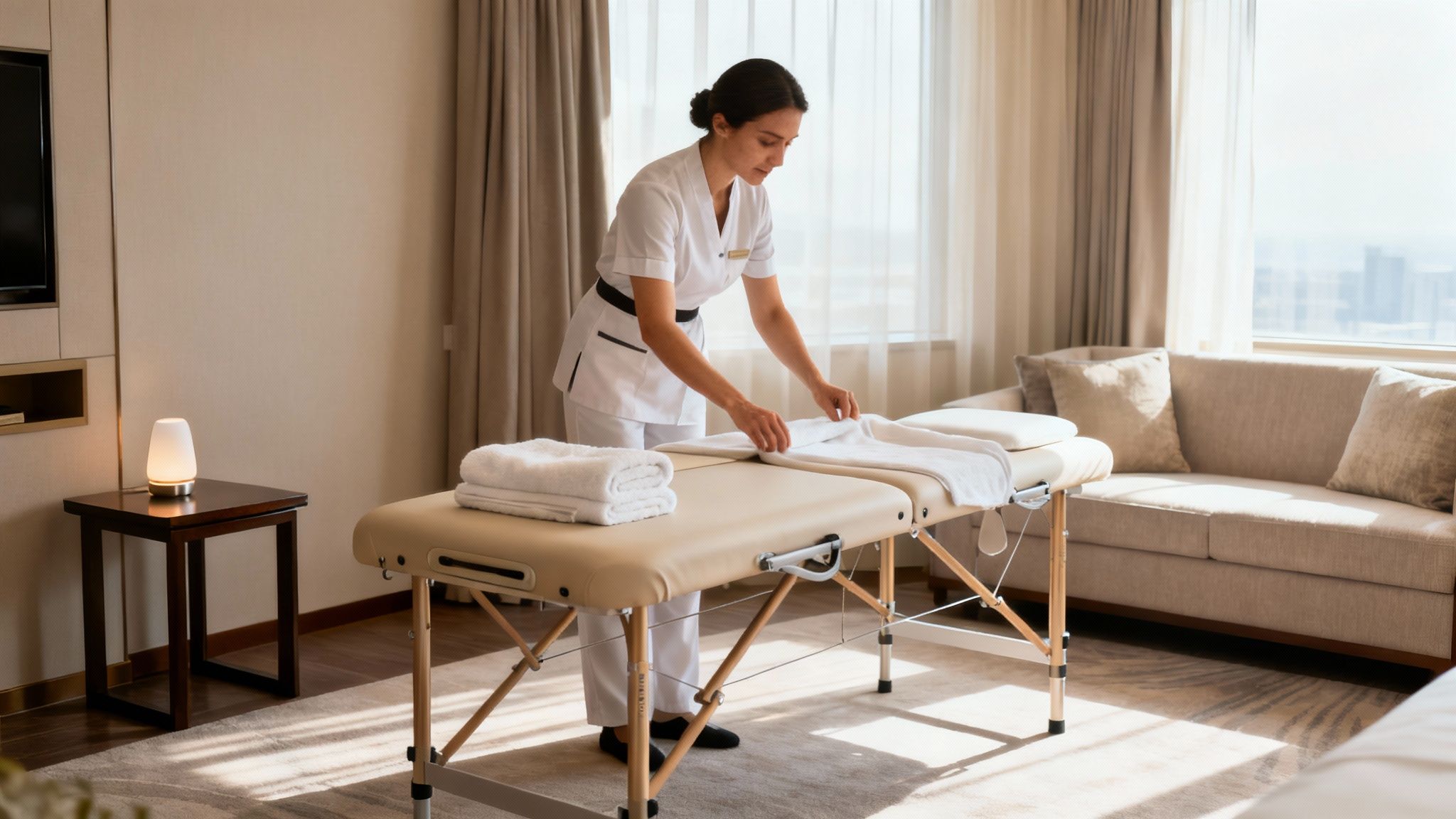
A masseuse in a white uniform prepares a massage table with fresh towels in a bright room.

From Hotel Rooms to Harbour Views

The possibilities for relaxation are almost endless, stretching far beyond the typical home or office setting.

  • The Hotel Escape: For a couple visiting Melbourne or the Gold Coast, a massage in their hotel room adds another layer of luxury to their getaway. It's the perfect way to unwind after a day of sightseeing, creating a shared, memorable experience without ever leaving their suite.
  • The Ultimate Opulence: Picture a day out on a yacht in Sydney Harbour. Adding a professional massage service elevates the whole experience. Guests can enjoy the serene water views while a therapist works to release tension, creating a truly unforgettable day of indulgence.

A mobile massage gift certificate removes the biggest barrier to self-care—inconvenience. It delivers a premium wellness experience directly to the recipient, making it one of the most thoughtful and practical gifts imaginable.

This level of service turns a simple gift into a standout memory. By bringing the spa to them, you’re not just giving a massage; you’re giving the precious gift of time, comfort, and effortless rejuvenation. For those curious about the specifics of arranging such a service, exploring options for a mobile massage therapy session in Sydney can provide a clearer picture of how this premium experience is delivered.

Ultimately, a gift certificate for a mobile massage shows you truly understand what the recipient needs. It acknowledges their busy life and provides the perfect, stress-free solution for their wellbeing, ensuring they feel cared for, valued, and completely refreshed.

Making Your Gift Certificate Truly Memorable

A massage gift certificate is already a wonderful gesture, but it’s the personal message that turns it from a good gift into a truly great one. The words you choose can deepen the sense of care and anticipation, making the person feel genuinely seen and appreciated. It’s that small, personal touch that elevates the entire experience, transforming a simple voucher into a memorable moment.

This isn’t about writing a long essay; a few sincere sentences are all it takes. The goal is to connect the gift of massage to a specific reason you're giving it. Whether it's for a birthday, a work milestone, or just because, your message sets the tone and makes the gift feel personal and heartfelt.

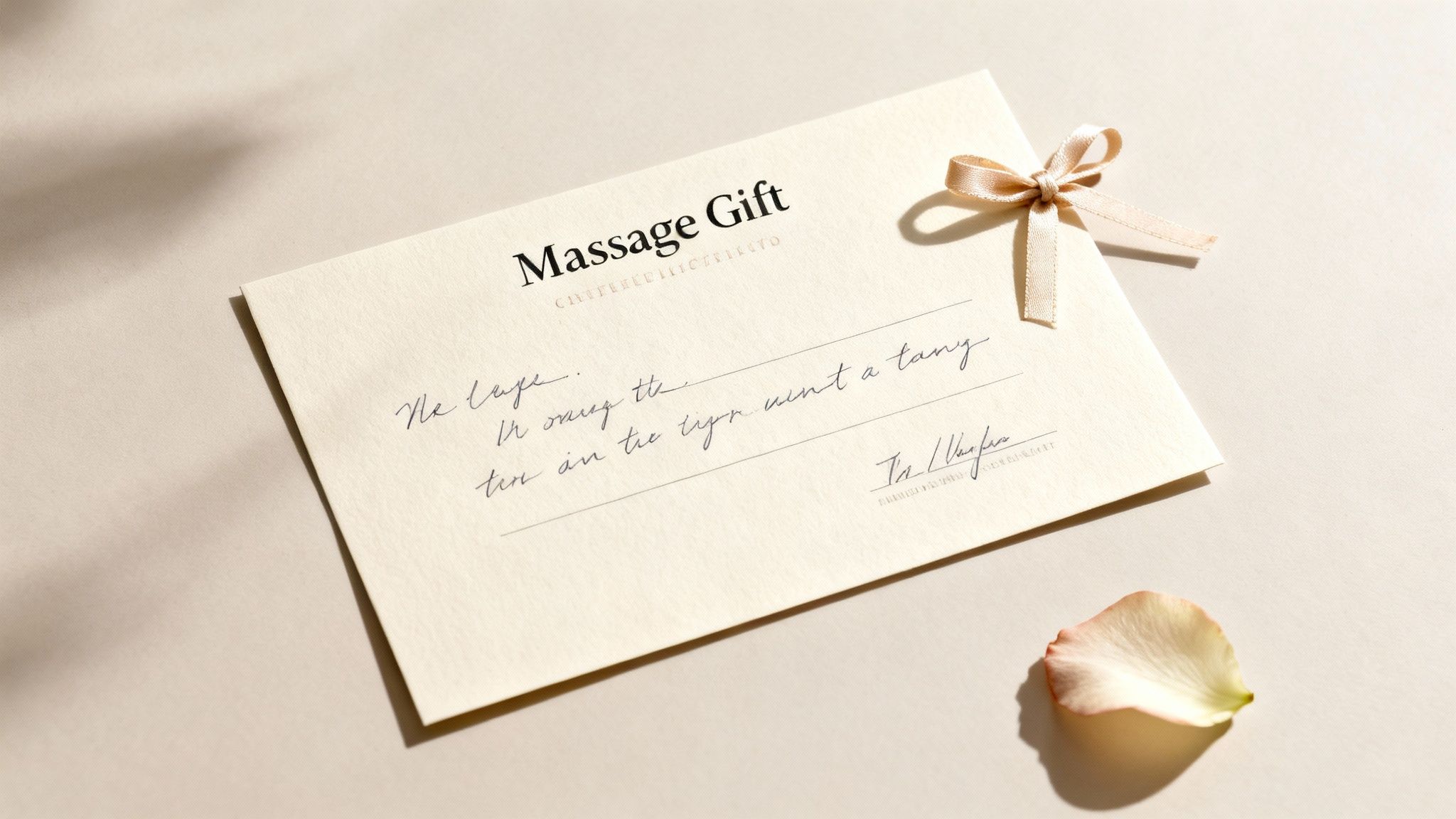
A light-colored 'Massage Gift' certificate with a golden ribbon and a delicate rose petal.

Crafting the Perfect Message for Any Occasion

Finding just the right words can sometimes feel tricky, so here are a few simple templates to get you started. Feel free to adapt these for any situation, whether you’re sending encouragement to a colleague or a loving note to your partner. The key is simply to be genuine.

For a Partner’s Birthday or Anniversary:

  • “Happy Birthday! You do so much for everyone else, so this is a moment just for you. Time to relax and recharge. Love you always.”

For a Colleague’s Achievement:

  • “Congratulations on the huge success with the project! You’ve earned a proper break. Hope you enjoy this chance to unwind.”

For a Friend Needing Support:

  • “Thinking of you and everything you’re juggling. I hope this gives you a quiet hour to switch off and feel cared for. You deserve it.”

A well-crafted message bridges the gap between the physical gift and its emotional impact. It tells the recipient not just that you bought them something, but why you thought of them, making the experience feel special from the moment they read your note.

Simple Steps to Add Your Personal Note

Adding your message when you buy a massage gift certificate online is designed to be completely straightforward. As you go through the checkout process, you’ll find a dedicated field where you can type your personal note. This message will then be beautifully included with either the digital e-voucher or the physically posted certificate.

Presentation also matters. A thoughtfully presented physical certificate with your handwritten note adds a classic, personal touch. For an instant e-voucher, your typed words provide the warmth and connection that makes the digital delivery feel just as special, ensuring your thoughtful gift makes a lasting impression.

How to Redeem a Massage Voucher for Pure Relaxation

So, you've been given a massage gift certificate—the perfect ticket to a well-deserved escape. The whole point of a gift like this is pure, effortless relaxation, and that starts from the moment you decide to book. We've made the process incredibly simple, so there's nothing standing between you and your moment of calm.

With just a few clicks, you can turn that voucher into a premium massage experience delivered right to your door, whether you're at home, in the office, staying at a hotel, or even out on a yacht.

Your Step-by-Step Booking Guide

The quickest and easiest way to lock in your session is by booking online. We've designed the entire process to feel smooth and intuitive, building that sense of anticipation for the treatment ahead.

  1. Head to the Booking Page: Jump onto our website’s online booking portal.
  2. Pick Your Service and Time: Choose the type of massage and the session length that’s listed on your gift certificate.
  3. Enter Your Details: Let us know your location and when you'd like your appointment.
  4. Pop in Your Voucher Code: At the checkout, you'll see a field for a "Gift Certificate" or "Promo Code." Simply type in your unique code, and the value will automatically be taken off the total.
  5. Confirm and Get Ready to Relax: Once that's done, you'll get a confirmation email with all the details. Simple as that.

This way, turning a thoughtful gift into a reality is completely stress-free.

Planning Your Session

With a network of highly skilled therapists, finding a time that works for you is a breeze. The wellness industry in Australia is booming, with an estimated 18,900 massage therapists expected to be working by 2025. The highest concentration of these professionals is in New South Wales (37.9%) and Victoria (23.6%), which means we have excellent availability right across the major cities. If you’re a numbers person, you can see more data on wellness professionals over at the Jobs and Skills Australia website.

Your only job is to clear your schedule and prepare to completely unwind. On the day, your therapist will arrive with everything needed to transform your space into a tranquil, spa-like sanctuary.

Just remember to check the validity period on your voucher—it’s typically three years, which gives you plenty of time to find that perfect moment for your wellness escape.

Your Massage Gift Certificate Questions, Answered

Thinking about giving the gift of a five-star massage? It’s a brilliant idea, but it’s completely normal to have a few practical questions pop up. We've put together some quick, clear answers to the most common queries we get, so you can feel totally confident you’re giving the perfect present.

How Long Is the Certificate Valid For?

Life gets busy, we get it. That's why, in line with Australian consumer law, our gift certificates are valid for a very generous three years from the day you buy them. This gives your lucky recipient all the flexibility they need to book their session at a time that truly works for them, ensuring they can completely switch off and enjoy the experience.

Can the Recipient Choose Their Massage Style?

Of course! A gift certificate from us is a ticket to a specific amount of time, not a specific type of massage. The person you’re gifting it to is always encouraged to have a chat with their therapist right before the session. This way, they can choose the exact treatment that suits what their body needs on the day – whether it’s pure relaxation at home, deep tissue work in their hotel, or some remedial therapy to ease office aches.

Which Areas Do You Service?

We bring our luxury mobile massage experience right to the doorstep in Australia’s major metro areas, including Sydney, Melbourne, Brisbane, and the Gold Coast. Our therapists are experts at creating a peaceful sanctuary just about anywhere, from a private home or corporate office to a hotel room or even a yacht on the harbour.

Is a Couples Massage an Option?

Yes, and it’s an incredibly popular choice for anniversaries, birthdays, or just a special shared treat. You can easily select the couples massage option when you purchase a gift certificate online. It’s a wonderful way to give the gift of a shared relaxation experience they won’t forget.


Ready to give an unforgettable wellness experience? Purchase the perfect gift of relaxation from The Royal Masseur and let us deliver a five-star treatment directly to their door. https://theroyalmasseur.com.au

Posted on Leave a comment

Thai Massage at Home: Your Actionable Guide to Deep Relaxation

Booking a Thai massage at home brings the ancient art of therapeutic stretching and acupressure right to your doorstep, cutting out the travel and weaving genuine wellness into your packed schedule. This is about transforming your personal space—whether it's your office for a midday reset, a hotel room while travelling, or even a yacht for the ultimate luxury—into a private sanctuary for deep relaxation and healing.

Why Mobile Thai Massage Is Transforming Australian Wellness

A smiling professional therapist enters a bright modern living room, carrying a yoga mat and basket.

The concept of wellness in Australia is shifting. It’s no longer a luxury saved for a rare spa trip; proactive self-care is becoming an essential part of a productive life. The rise of mobile Thai massage directly addresses the realities of modern living, where time is a premium resource and convenience is paramount.

For busy professionals in the office, parents managing family life, or anyone needing to decompress, the traditional wellness model can feel out of reach. This is where the practicality of an in-home or on-location service truly excels.

The Ultimate Convenience for a Modern Lifestyle

Imagine this: no battling city traffic, no searching for parking, and no clinical waiting rooms. Instead, a qualified therapist arrives at your location—be it your home, office, or hotel—fully equipped to create a professional treatment space. This isn't just a time-saver; it’s an energy-saver, allowing you to focus entirely on the restorative experience.

The actionable benefits of bringing wellness to you are significant:

  • Deep Relaxation in a Trusted Space: Being in a familiar environment like your home or a private office allows your nervous system to relax more quickly, enabling a deeper state of calm from the outset.
  • Total Privacy and Control: You dictate the environment. The lighting, temperature, and choice of music (or silence) are all tailored to your preference, creating a truly personalised session.
  • Seamless Integration: A massage can be scheduled during a work-from-home lunch break, booked for an evening at your hotel, or used as a restorative end to a long day on your yacht without disrupting your entire schedule.

This move toward convenience-based wellness is more than a trend. The mobile massage market is expanding across Australia, with strong networks in major hubs like Sydney and Melbourne. This growth is fuelled by consumer demand for practical solutions.

Considering many Australians spend significant time commuting, eliminating travel for a wellness appointment is a powerful efficiency hack. You can explore more on the benefits of mobile massage versus a traditional spa to see how this model provides tangible advantages.

By bringing therapy to your preferred location, a Thai massage at home, in the office, or at your hotel removes the logistical barriers that prevent consistent self-care. It’s a practical and effective way to manage stress, ease physical tension, and find genuine peace in a demanding world.

Setting the Scene for Your At Home Massage

An authentic Thai massage experience begins before the therapist arrives. The key is creating a sanctuary—a quiet bubble where your mind can switch off and your muscles can release tension. This preparation is crucial, whether you're clearing a space in your office for a professional visit or setting up in your living room.

Think of it as signalling to your body that it’s time to de-stress. A few simple, actionable tweaks can transform any room into a peaceful retreat, enhancing the therapeutic power of the massage.

Choosing and Preparing Your Space

First, find a room where you can have uninterrupted privacy. A living room, a quiet home office after hours, or a spacious hotel suite can be perfect. The most important requirement is ample floor space. Traditional Thai massage is performed on a mat, so you’ll need a clear area of at least 2 by 2.5 metres to accommodate the dynamic stretches and movements.

Once you have your space, focus on the surface. A hard floor is unsuitable, but an overly soft bed lacks the necessary stability.

  • The Ideal Surface: A firm yoga mat is a good foundation. A futon mattress or a thick, folded blanket over a rug provides the perfect balance of comfort and support.
  • Comfort Essentials: Have a couple of pillows and a light blanket on hand. Pillows offer excellent support under the knees or head, while a blanket is useful for staying warm as your body temperature can drop during deep relaxation.

Remember, the foundation of a great Thai massage at home is about function and simplicity. A quiet, clear, and comfortable floor space is the most critical element to arrange for yourself or your therapist.

Crafting the Perfect Ambience

With the physical space ready, it’s time to engage the other senses. These details elevate a simple massage into a restorative ritual.

Adjust the room temperature to be slightly warmer than usual, as you won't be moving. Dim bright overhead lights and use a soft lamp to create a calming glow.

Finally, consider sound. For some, a playlist of calming instrumental music or nature sounds works best. For others, pure, uninterrupted silence is the ultimate luxury. There is no right answer; choose what feels most relaxing for you.

Taking a few minutes for this setup creates an environment that amplifies the healing power of the massage, making your Thai massage at home a genuinely profound wellness experience.

Your At Home Thai Massage Preparation Checklist

Here’s an actionable checklist to ensure you have everything ready for a seamless and relaxing massage experience, whether you're hiring a professional or practising with a partner.

ElementProfessional Therapist VisitDIY/Partner MassagePro Tip
SpaceClear a 2 x 2.5 metre area on the floor.Clear a 2 x 2.5 metre area on the floor.Choose a room with a door you can close to minimise interruptions.
SurfaceHave a yoga mat or thick blanket ready.Have a firm yoga mat, futon, or folded blanket ready.A surface that's too soft (like a bed) won't provide the right support for Thai stretches.
ComfortProvide a few pillows and a light blanket.Have pillows and a blanket within easy reach.Pillows are great for supporting the knees, neck, or lower back during certain positions.
TemperatureSet the room to a comfortable, slightly warm temp.Make sure the room is warm enough to relax in without moving.A slightly warmer room prevents you from feeling chilled as your body relaxes.
LightingDim the lights or use a soft lamp.Dim the lights or use a soft lamp.Avoid harsh overhead lighting to help the eyes and mind rest.
SoundAsk the therapist if they bring music, or have a quiet space.Choose calming music or enjoy complete silence.Let your partner know your sound preference beforehand to avoid distractions.
ClothingWear loose, comfortable clothing like yoga pants and a t-shirt.Wear loose, comfortable clothing you can move freely in.Stretchy, breathable fabrics work best. Avoid jeans or restrictive clothing.

These small, actionable steps ensure that once the massage begins, your only task is to breathe, relax, and enjoy the full therapeutic benefits.

Mastering Simple Thai Massage Techniques with a Partner

Sharing the healing power of touch is an excellent way to connect with a partner. You don’t need extensive training to provide genuine relief and relaxation at home. Learning a few basic Thai massage techniques is simpler than you might imagine. The goal isn’t to replicate a professional treatment but to use simple, safe movements to help each other unwind.

The secret is to use your body weight for gentle, rhythmic pressure, rather than muscle strength. This makes the massage less tiring for the giver and more effective for the receiver. It becomes a collaborative practice that builds trust and communication while easing tension.

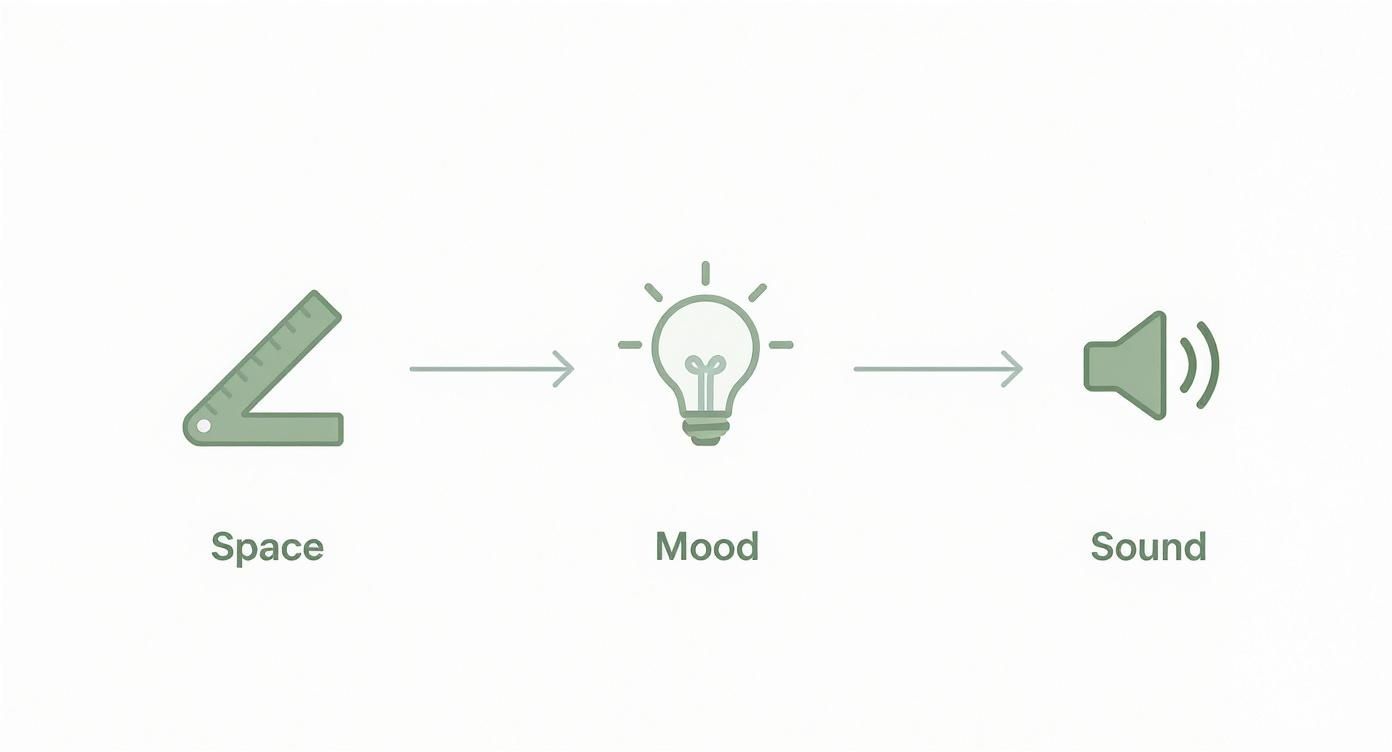
This visual guide shows the importance of environmental details. The right space, mood, and sound work together to create the perfect atmosphere.

A diagram illustrates space influencing mood, which then influences sound, using icons and text.

It highlights that a successful Thai massage at home starts with intentionally crafting a peaceful environment before any techniques are applied.

Foundational Moves Anyone Can Learn

First, have your partner lie comfortably on their back on a firm mat. Kneel beside them and take a few deep breaths together to sync up and settle into the moment. Always maintain open communication, checking in regularly about pressure and comfort.

A great starting point is the simple palm press.

  1. Place one hand over the other on your partner's thigh.
  2. Lean forward, using your body weight to apply slow, steady pressure. Focus on leaning, not pushing.
  3. Hold for three to five seconds, then release gently.
  4. "Walk" your hands up their leg in this manner, moving from the thigh towards the calf, avoiding the kneecap. This action warms the muscles and improves blood flow.

This technique can be used on the arms, back, and feet. The key is the slow, rhythmic application of pressure, which is very calming for the nervous system.

Remember, the goal is to create a space for relaxation and release, not to "fix" a problem. Your intention and gentle touch are your most powerful tools.

Simple Assisted Stretches for Shoulders and Back

Modern life, with its focus on screens, often leads to tight shoulders and aching backs. A few simple assisted stretches can provide incredible relief. For those seeking more targeted solutions, understanding professional approaches can be beneficial. You can learn more in our detailed guide to achieving neck and shoulder pain relief for deeper insights.

Here’s a safe and effective stretch to try together:

  • Gentle Spinal Twist: Have your partner lie on their back with knees bent and feet flat on the floor. Gently guide both knees to one side, encouraging them to keep both shoulders flat on the mat. Hold for a slow count of ten, then return to the centre and repeat on the other side.
  • Shoulder Opener: With your partner sitting cross-legged, kneel behind them. Place your hands on the front of their shoulders and gently draw them back to open up the chest. Hold for a few deep breaths, ensuring you're not pulling too hard.

Communication is non-negotiable. Thai massage can be intense, but it should never be sharply painful. Encourage your partner to speak up if the pressure is too much or a stretch feels uncomfortable. This feedback loop is essential for a safe and enjoyable experience for both of you.

Finding and Booking a Professional Mobile Massage Therapist

While practising with a partner is beneficial, there are times when the skill of a professionally trained therapist is needed for a truly therapeutic Thai massage at home. This is the best approach for addressing specific aches, chronic pain, and the deep-seated tension from modern life.

With many options available, especially in cities like Sydney and Melbourne, how do you find the right therapist? It's about knowing what to look for: qualifications, professionalism, and the right specialisation. This ensures you book a safe, effective, and deeply restorative experience.

Vetting Your Therapist for a Safe and Effective Session

Your peace of mind is paramount. When inviting a mobile massage therapist into your personal space, there are a few non-negotiables to verify. These credentials signify a professional committed to high standards of practice and client safety.

Before booking, ensure the therapist or their company can confirm the following:

  • Formal Qualifications: Look for a Diploma of Remedial Massage or an equivalent certification from a recognised Australian institution. This demonstrates a thorough understanding of anatomy and physiology.
  • Association Membership: Membership in a professional body like Massage & Myotherapy Australia (MMA) indicates adherence to a strict code of ethics and professional standards.
  • Current Insurance: Always confirm that the therapist holds current public liability and professional indemnity insurance. This is a crucial safety measure for both you and them.

A reputable therapist will be transparent about their qualifications and insurance. If this information isn't easily found on their website, don't hesitate to ask directly before booking. Your comfort and safety are the top priorities.

What to Expect During a Professional Home Visit

Once booked, the experience should be seamless and discreet. A professional mobile therapist understands they are entering your private space—be it your home, office, hotel room, or yacht—and will act with the utmost respect.

They will arrive with all necessary equipment, including a high-quality floor mat, fresh linens, and any bolsters or pillows needed for proper support. Their setup is quick and quiet, transforming your chosen space into a professional treatment area in minutes.

The session will begin with a brief consultation. This is your opportunity to discuss any issues, such as lower back tightness from sitting or shoulder tension from stress. Good communication allows the therapist to tailor the session to your specific needs. They will check in about pressure throughout the massage to ensure the intensity is right for you.

With a strong professional infrastructure in Australia, finding a qualified practitioner is straightforward. Thai massage is a sought-after specialty. New South Wales has 525 therapists, Victoria has 351, and Queensland has 196. As shown by data on Thai massage therapists in Australia, there is a significant, formally recognised workforce available.

Ultimately, the right choice is someone who meets professional standards and aligns with your wellness goals. For a deeper dive, our guide on how to find the right mobile massage therapist for your needs offers more practical tips. A little research upfront ensures you can book with confidence and receive the full benefits of a professional treatment.

The Unique Physical and Mental Benefits of Thai Massage

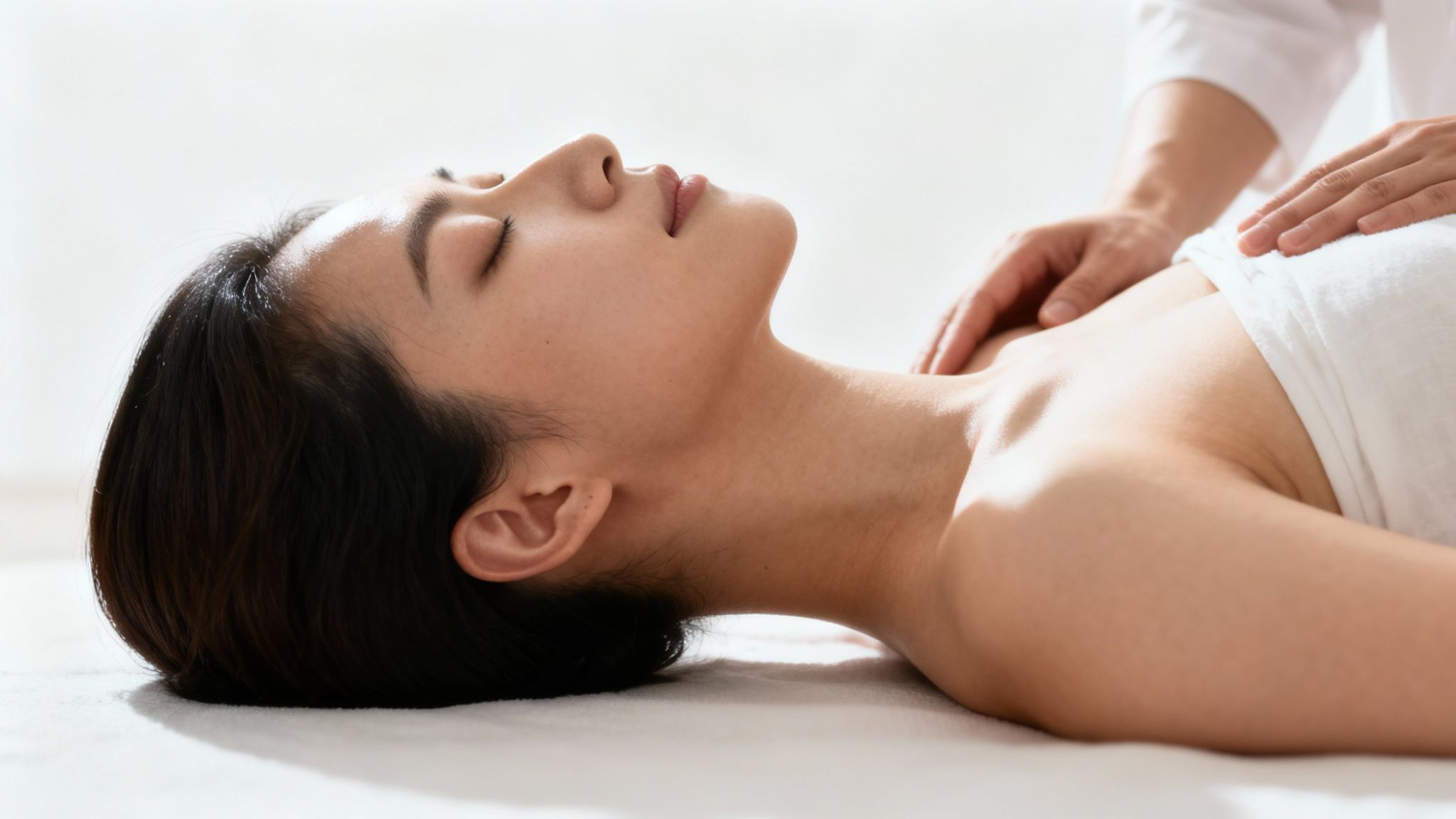
A serene young woman receiving a relaxing neck and shoulder massage from a therapist.

What makes a Thai massage at home feel so different from a standard massage? It’s the dynamic, whole-body approach that offers benefits beyond simple muscle relaxation. This isn’t a passive experience; it's an active, energising therapy that directly addresses the challenges of a modern, often sedentary lifestyle.

The unique combination of rhythmic acupressure, assisted yoga-like stretches, and gentle compression works on multiple levels. This method doesn't just knead sore muscles; it works systematically to unblock energy pathways, lengthen tight fascia, and create a sense of spaciousness in the body that lasts long after the session.

Releasing Modern-Day Tension

Consider your daily routine: hours hunched over a laptop in the office, constant phone use, or long commutes. These activities create specific patterns of tension. Thai massage is designed to counteract these modern ailments.

The deep, methodical stretches are particularly effective for issues like 'tech neck' and lower back pain from prolonged sitting. By mobilising the hips, elongating the spine, and opening the chest and shoulders, the massage helps restore natural posture and ease chronic stiffness. This not only relieves pain but also boosts energy by improving blood flow and releasing physical restrictions. For other ways to support your body's systems, check our guide on how to improve circulation naturally.

This active approach is why many people feel both deeply relaxed and invigorated after a session. It’s a complete reset for your body's physical structure and energy flow, leaving you feeling lighter, more flexible, and mentally clearer.

A Powerful Tool for Mental Clarity

The benefits are as much mental as they are physical. The rhythmic, meditative nature of the massage fosters a state of mindfulness, pulling your focus away from endless to-do lists and grounding you in the present. This focused attention helps quiet a busy mind, reduce stress, and promote a profound sense of calm.

This is particularly relevant for busy Australians, especially women balancing demanding careers and family life. Effective stress management has made practices like Thai massage a vital part of their wellness routine. Research shows that among mid-aged and older Australian women, 7.7% consulted a massage therapist in the last year. It’s not surprising that women represent 61.19% of the global market share for massage services in 2023.

This trend reflects a growing recognition of massage as a crucial tool for managing the physical and mental demands of a busy life. You can discover more about these findings on women's health and massage therapy.

Your At-Home Thai Massage Questions, Answered

Bringing the Thai massage experience into your own space for the first time can bring up a few practical questions. Sorting out the details beforehand is key to ensuring your session is seamless, comfortable, and tailored to your needs.

Here are straightforward answers to the most frequently asked questions.

What Should I Wear for a Thai Massage at Home?

For a traditional Thai massage, you remain fully clothed. The best attire is loose, comfortable clothing that allows for a full range of motion—similar to what you would wear for yoga or Pilates.

Lightweight tracksuit pants, leggings, or loose-fitting trousers and a t-shirt are ideal. Avoid restrictive clothing like jeans or items with belts, zips, and buckles. Your therapist needs to be able to move your limbs freely to guide you through the assisted stretches central to the practice.

Do I Need My Own Massage Table?

No, you do not. In fact, a massage table is not used in authentic Thai massage. This traditional therapy is always performed on a firm, padded mat on the floor.

When you book a professional mobile therapist, they arrive with all necessary equipment. This includes a high-quality, comfortable floor mat and any bolsters or pillows required for extra support. Your only responsibility is to ensure there is enough clear floor space for them to set up, typically around 2 metres by 2.5 metres.

Is Thai Massage Painful?

Thai massage is often described as intense, but it should never be outright painful. You will feel deep pressure and significant stretching, which can create a strong sensation in tight areas. Many clients refer to this as a "good pain" because it is accompanied by a powerful feeling of release.

Open communication is crucial. If any movement or pressure feels sharp or excessive, you must inform your therapist immediately. A skilled practitioner will adjust their technique to work within your comfort zone. Tensing up in pain is counterproductive to the goals of the session.

Certain health factors should also be considered. Thai massage is not recommended for individuals with serious heart conditions, recent surgeries, or severe osteoporosis. Always disclose your full health history before the session begins.

How Is a Mobile Massage in a Hotel or on a Yacht Different?

While the quality and technique of the massage remain the same, the logistics for unique locations like a hotel room or yacht differ slightly. For a hotel visit, you may need to arrange access for the therapist with the concierge or meet them in the lobby.

On a yacht, the primary considerations are space and stability. The therapist will require a flat, stable area to work, so scheduling the session while docked or in calm waters is essential for safety and comfort. Experienced mobile therapists are adept at discretion and skilled in adapting to these exclusive environments to provide a five-star experience, wherever you are.


Ready to experience the ultimate in convenience and relaxation? The Royal Masseur brings expert Thai massage and a full suite of wellness services directly to your home, office, or hotel. Book your session today at https://theroyalmasseur.com.au and discover a new level of wellbeing.
Posted on Leave a comment

Finding the Best Massage for Your Back Pain: A Practical Guide

Back pain is more than a minor ache; it's a persistent issue that can sabotage productivity in the office, disrupt a holiday, or simply make daily life a struggle. With a confusing number of therapies available, finding the truly best massage for back pain can feel impossible. This guide simplifies the process, offering a practical roadmap for Australians seeking effective, convenient relief—whether you're at home, in a hotel, on a yacht, or even at work. We move beyond generic advice to provide a detailed breakdown of specific massage techniques tailored to different types of back pain and real-life situations.

This isn't just a list; it's an actionable resource for your busy lifestyle. We’ll explore eight distinct methods, from the targeted pressure of remedial massage to the holistic approach of Shiatsu. We will detail what to expect during a session, which conditions each therapy best addresses, and how you can maximise the benefits afterwards.

The focus is on real-world application, whether you need to organise corporate wellness for your team in a Sydney high-rise, book a therapeutic session for your hotel room in Melbourne, or arrange a five-star treatment on a private yacht. You will learn not just what works, but how to integrate these powerful wellness practices into your life. We provide insights from leading Australian health sources and practical guidance for accessing premium mobile services like The Royal Masseur, who bring expert therapists directly to you, ensuring relief is always within reach. Let's find the right solution for your back.

1. Swedish Massage

Often seen as the classic Western massage, the Swedish technique is an excellent starting point for anyone seeking relief from general back pain. It focuses on relaxing the entire body using a series of specific, therapeutic strokes. It is perhaps the most well-known style, making it a reliable and accessible choice whether you’re at home, in a hotel, or as part of a corporate wellness program in a busy Sydney office.

This technique is characterised by five primary strokes: long, gliding strokes (effleurage), kneading (petrissage), rhythmic tapping (tapotement), friction, and vibration. For back pain, these movements work together to warm up muscle tissue, release tension, and break down minor muscle knots. The long, flowing strokes are particularly effective at soothing the nervous system and reducing the stress that often contributes to a tight, sore back.

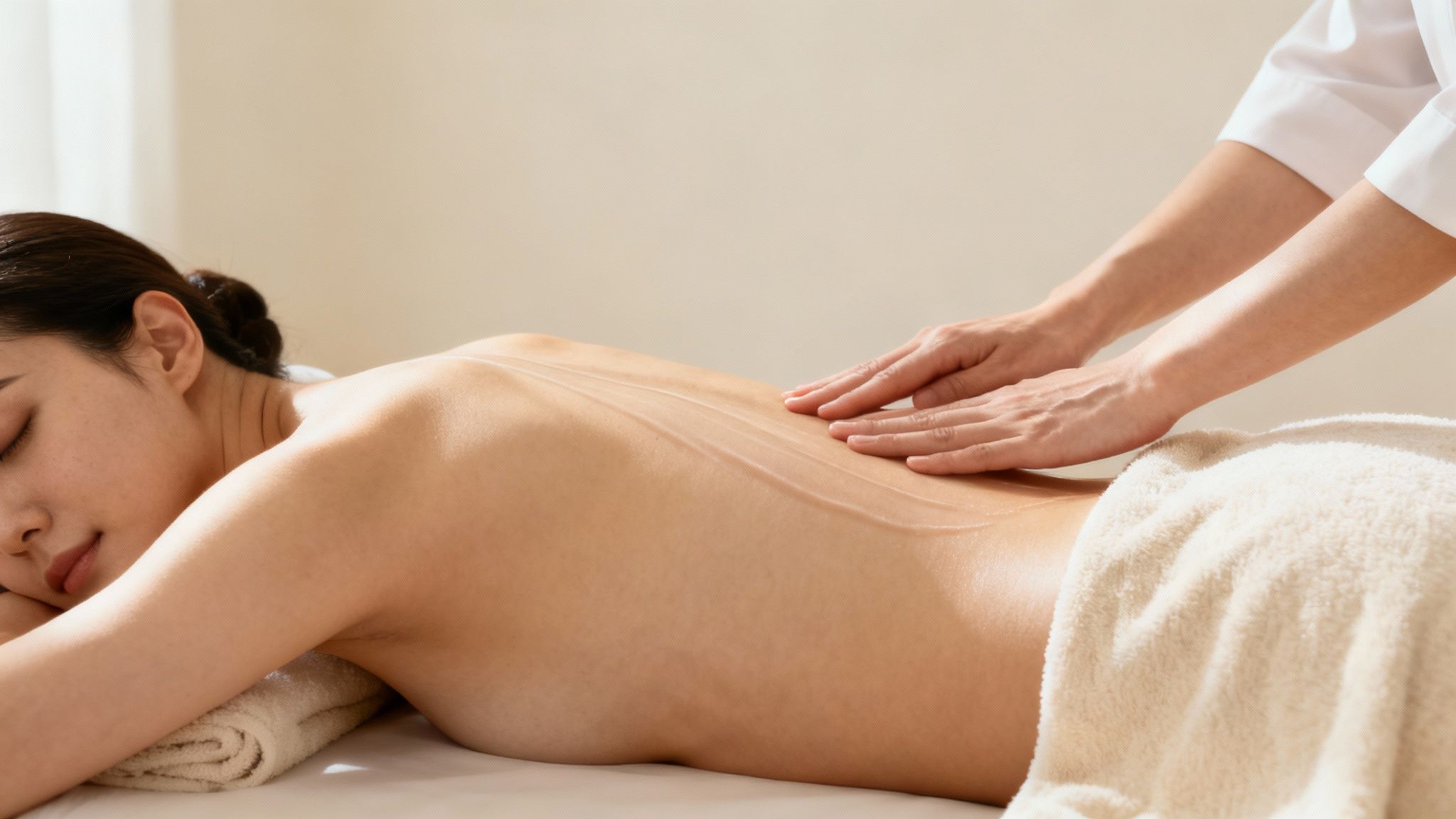
A woman receives a relaxing back massage with lotion applied, looking peaceful in a spa setting.

Why It's One of the Best Massages for Back Pain

Swedish massage excels at addressing vague, non-specific back pain caused by muscular tension and poor circulation. By increasing oxygen in the blood and decreasing muscle toxins, it helps shorten recovery time from muscular strain. This circulatory boost is a key reason it’s considered an effective massage for back pain. To explore more ways to enhance your body's circulation, you can learn more about improving circulation naturally.

It is the ideal choice for individuals new to massage or those sensitive to deep pressure. If your back pain stems from long hours at a desk, general stress, or mild overuse, the gentle yet firm approach of a Swedish massage can provide significant relief without the intensity of more targeted therapies.

Actionable Tips for Your Session

To get the most out of your Swedish massage, follow these practical steps:

  • Be Specific: Before the session begins, point out the exact areas of your back that are causing discomfort. Use a pain scale from 1 to 10 to help your therapist understand the intensity.
  • Book for Maintenance: For chronic but mild back tension, a single session offers temporary relief. Booking regular appointments—perhaps monthly—helps manage muscle tension proactively. This is easily arranged for corporate wellness days or as a regular home visit.
  • Hydrate After: Drink plenty of water after your massage. Hydration helps your muscles and fascia stay pliable and assists in flushing out metabolic waste released during the session.
  • Prepare Your Space: If booking a mobile service, have a quiet, warm space ready. A warm shower or a few gentle stretches before your therapist arrives can also help relax your muscles, allowing for a more effective massage.

2. Deep Tissue Massage

For those suffering from chronic back pain, deep tissue massage offers a more intensive and targeted approach. Unlike the broad, relaxing strokes of Swedish massage, this technique focuses on the deeper layers of muscle and connective tissue, known as fascia. Using slow, deliberate strokes and firm, concentrated pressure, therapists work to release chronic muscle tension and break down painful adhesions (knots) that often cause persistent back issues.

This method is particularly powerful for addressing specific problem areas in the back, such as a stiff lower back or sore, tight shoulders from long hours at a computer. It's a go-to therapy for individuals dealing with recurring pain, making it a valuable service whether you're recovering from a strain at home in Melbourne or seeking relief from occupational stress in a high-rise Brisbane office.

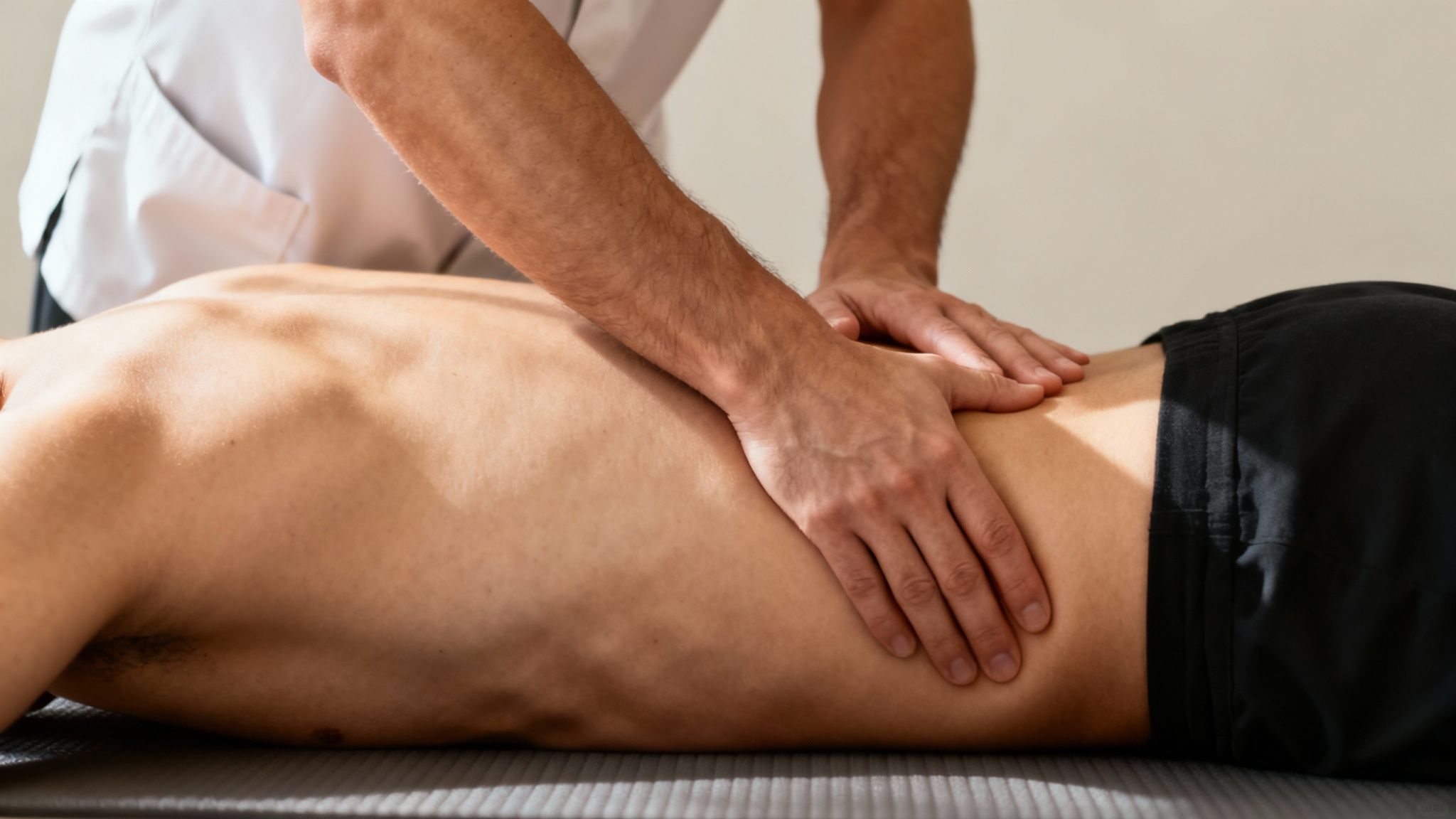
A person receiving a professional back massage for pain relief on a mat.

Why It's One of the Best Massages for Back Pain

Deep tissue massage is highly effective because it addresses the root causes of many types of chronic back pain. By breaking up scar tissue and physically releasing muscle knots, it can improve range of motion, reduce inflammation, and alleviate pain. This makes it an excellent choice for conditions like chronic lower back pain, postural problems, and muscle injuries.

It's the ideal massage for back pain when general relaxation isn't enough. If your discomfort is localised, persistent, and feels deep within the muscle, the focused pressure of a deep tissue session can provide significant and lasting relief. It is frequently used by athletes and therapists treating desk workers with deep-seated tension.

Actionable Tips for Your Session

To ensure your deep tissue massage is both safe and effective, here’s how to prepare:

  • Communicate Your Comfort Levels: Deep tissue should be firm, but it shouldn't be excruciating. Use a "stoplight" system: let your therapist know if the pressure is "green" (good), "yellow" (intense but tolerable), or "red" (too painful).
  • Allow for Recovery: Your muscles need time to heal after an intense session. Avoid strenuous activity for at least 24 hours afterwards.
  • Warm Up and Cool Down: Applying a heat pack to your back for 10-15 minutes before your session can help warm up the muscles. If you experience soreness afterwards, an ice pack can help reduce inflammation.
  • Focus on Posture: Maintain the benefits between sessions by being mindful of your posture at your desk or while driving. This helps prevent the muscles from tightening up again.

3. Trigger Point Therapy

Trigger point therapy is a highly targeted technique designed to locate and deactivate specific "trigger points"—hyperirritable knots within a tight band of muscle. These points can cause both direct pain at the site and referred pain in other parts of the body, a common source of confusing backaches. The therapy involves applying sustained, direct pressure to these knots to release tension and break the pain-spasm cycle.

Unlike a full-body relaxation massage, this method is focused, zeroing in on the root cause of the discomfort. For back pain, a therapist might identify a trigger point in the hip that is referring pain down your leg, or a knot in the trapezius causing tension across your upper back and neck. This precision makes it an incredibly effective massage for back pain when the issue stems from specific muscular dysfunction. It's a treatment that can be conveniently performed in various settings, from a quiet room in your Gold Coast home to a dedicated wellness space in your office.

Why It's One of the Best Massages for Back Pain

Trigger point therapy excels at resolving complex, nagging back pain that doesn’t respond to broader massage techniques. By directly addressing the source of referred pain, it can alleviate symptoms in areas that aren't even being touched. This approach is invaluable for conditions like sciatica-like symptoms or chronic upper back pain from poor posture at a desk.

This therapy is ideal for individuals experiencing specific, localised pain or stiffness. If you can point to a distinct "spot" that hurts, or if your pain radiates from one area to another, trigger point therapy offers a diagnostic and therapeutic solution that can provide profound and lasting relief.

Actionable Tips for Your Session

To get the most from your trigger point therapy session, follow these practical steps:

  • Communicate Pain Levels: This therapy can be intense. Use a pain scale from 1 to 10 and let your therapist know when the pressure reaches a "good pain" level (around a 7) versus an intolerable one.
  • Breathe Through the Pressure: When the therapist applies pressure, focus on deep, slow breathing. This helps relax the muscle and makes the release more effective and less painful.
  • Manage Post-Session Soreness: Expect some mild soreness for 24-48 hours, similar to post-workout fatigue. Apply a cold pack for 10-15 minutes to reduce inflammation if needed.
  • Incorporate Self-Care: Use a tennis or lacrosse ball to apply gentle pressure to accessible trigger points between sessions. A few minutes daily can prolong the benefits of your professional treatment.

4. Shiatsu Massage

Originating from Japan, Shiatsu is a therapeutic bodywork technique that translates to "finger pressure." It is deeply rooted in Traditional Chinese Medicine and works to restore the body's energy flow, or qi. Unlike oil-based Western massages, a Shiatsu session is typically performed with the recipient fully clothed, using rhythmic and sustained pressure from fingers, thumbs, and palms. This method is exceptionally effective for back pain as it targets specific acupressure points along the body’s energy channels.

The therapist applies pressure in a continuous, flowing sequence to release blockages and rebalance energy. For someone suffering from a stiff lower back or tension in the shoulders, this approach works to calm the nervous system, promote deep relaxation, and encourage the body’s natural healing capabilities. It’s a holistic treatment that addresses not just the site of the pain but the underlying imbalances contributing to it, making it an excellent choice for a restorative session at home or as part of a comprehensive corporate wellness day.

Why It's One of the Best Massages for Back Pain

Shiatsu stands out because it addresses both the physical muscles and the body's energetic system. It is particularly beneficial for chronic pain linked to stress, fatigue, or postural imbalances. By stimulating acupressure points along the spine, a Shiatsu therapist can help alleviate deep-seated tension and improve flexibility.

This technique is ideal for those who prefer an oil-free massage or feel more comfortable remaining clothed. If your back pain feels persistent and is accompanied by a sense of low energy, the focused, grounding pressure of Shiatsu can provide profound relief, restoring both physical comfort and overall vitality.

Actionable Tips for Your Session

To get the most from your Shiatsu massage, consider these practical recommendations:

  • Wear Loose, Comfortable Clothing: Choose breathable, non-restrictive garments like yoga wear or sweatpants to allow for easy movement and application of pressure.
  • Communicate Pressure and Points: While Shiatsu can be intense, it should never be painful. Let your therapist know if the pressure is too much and point out the specific areas along your back where you feel the most discomfort.
  • Embrace a Full-Body Approach: Shiatsu treats the body as an interconnected system. The therapist will likely work on your legs, arms, and neck to address the root cause of the imbalance, even if your pain is localised in your back.
  • Rest and Rehydrate Afterwards: Allow yourself some quiet time after the session. Drinking water helps to flush toxins and support the body’s energetic rebalancing process.

5. Myofascial Release

Going beyond the muscles, myofascial release targets the fascia: the tough, web-like connective tissue that surrounds every muscle, bone, and organ. When this tissue becomes tight due to injury, inflammation, or poor posture, it can exert immense pressure, causing significant back pain and stiffness. This technique uses sustained, gentle pressure and slow, stretching movements to release these fascial restrictions and restore mobility.

This approach is less about broad strokes and more about specific, sustained holds on areas of fascial tension. A therapist will use their hands, knuckles, or elbows to slowly sink into the tissue until they feel a release, helping to rehydrate the fascia and improve its elasticity. This makes it a powerful option for chronic pain that hasn't responded to traditional muscle-focused massage, offering relief right in your home or hotel room.

A woman on a yoga mat using a black foam roller for back pain relief and stretching.

Why It's One of the Best Massages for Back Pain

Myofascial release is exceptionally effective for back pain stemming from postural imbalances, such as those from prolonged sitting. By addressing the root cause within the connective tissue, it provides longer-lasting relief than simply relaxing the muscles. Poor posture is a common culprit of fascial restrictions, and you can discover more about posture's musculoskeletal effects to better understand this connection.

This technique is ideal for individuals with chronic, nagging back pain, limited range of motion, or pain that feels deep and widespread. It's also beneficial for post-surgical rehabilitation, helping to break down scar tissue and restore normal movement patterns.

Actionable Tips for Your Session

To get the most from a myofascial release session or your own at-home practice, consider these tips:

  • Go Slow at Home: If using a foam roller, move very slowly. When you find a tender spot, pause on it for 30-60 seconds, breathing deeply until you feel the tension ease.
  • Don't Push Through Sharp Pain: Myofascial release can be intense, but it should never be sharply painful. Communicate with your therapist if the pressure is too much, or ease off if you are self-treating.
  • Stay Hydrated: Fascia is primarily made of water. Drinking plenty of water after your session is crucial to help the tissue rehydrate and remain pliable.
  • Combine with Movement: For lasting results, follow your myofascial release work with gentle stretching. This helps the newly released fascia and muscles lengthen into their new, improved range of motion.

6. Remedial/Sports Massage

Remedial and sports massage offer a highly targeted, assessment-based approach to treating specific musculoskeletal issues. This is less a pampering session and more a clinical treatment designed to remedy the root cause of your back pain. A therapist will assess your posture and range of motion to devise a treatment plan that addresses injuries, imbalances, and chronic dysfunction.

This modality is a powerful fusion of various techniques, including deep tissue work and trigger point therapy, tailored precisely to your needs. For back pain, this might involve focused work on a strained lower back muscle from a sports injury or correcting postural imbalances from hours spent hunched over a desk in a Sydney high-rise. The goal is not just to alleviate pain but to restore optimal function and prevent recurrence.

Why It's One of the Best Massages for Back Pain

Remedial and sports massage are exceptionally effective for back pain that stems from a specific injury, postural strain, or repetitive overuse. Unlike more generalised massages, the treatment is strategic, focusing on the muscles, tendons, and ligaments directly contributing to your discomfort. It's the ideal choice for athletes managing strains, office workers suffering from "tech neck" radiating down their back, or anyone recovering from a specific incident.

By systematically breaking down scar tissue, improving muscle flexibility, and correcting imbalances, this approach provides lasting relief and enhances your body's resilience. It is a problem-solving massage that equips you with the tools for long-term recovery.

Actionable Tips for Your Session

To get the most from your remedial or sports massage, a proactive approach is key:

  • Be Specific About Your Goals: Clearly explain the nature of your back pain. Was it a sudden injury? Is it a dull ache that worsens throughout the day? The more detail you provide, the more customised your treatment will be.
  • Request a Postural Assessment: Ask your therapist to assess your posture and movement patterns at the start of the session. This provides a baseline and helps them identify underlying imbalances.
  • Commit to the Plan: Remedial therapy often requires a series of sessions. Adhere to the recommended treatment schedule to achieve cumulative and lasting results.
  • Follow Through with Homework: Your therapist will likely provide you with a home care plan, including specific stretches or strengthening exercises. Diligently performing these exercises is crucial for reinforcing the benefits of the massage.

7. Thai Massage

Often called “lazy person’s yoga,” Thai massage is an ancient and dynamic healing practice that offers a unique approach to alleviating back pain. This technique combines acupressure, Ayurvedic principles, and assisted yoga postures. Unlike oil-based massages performed on a table, a Thai massage is conducted on a floor mat with the client fully clothed in loose, comfortable attire.

The therapist uses their hands, thumbs, elbows, and even feet to apply firm, rhythmic pressure along the body’s energy lines. This is combined with a series of deep, passive stretches that pull, rock, and compress the body. For those with back pain, this method works to decompress the spine, increase flexibility, and release deep-seated tension, making it one of the best massages for back pain related to stiffness and poor mobility.

Why It's One of the Best Massages for Back Pain

Thai massage is exceptionally effective for back pain caused by muscular tightness, poor posture, and a lack of flexibility. The comprehensive stretching mobilises the joints and elongates the spine, which can relieve nerve compression and correct postural imbalances from sitting at a desk all day. Studies cited by sources like Nine.com.au have highlighted its benefits for improving flexibility and reducing pain.

This modality is ideal for active individuals or those who feel their back pain is linked to overall body stiffness. It offers a more engaging and energising experience, leaving you feeling both relaxed and invigorated. This makes it a great choice for a corporate wellness program in a dynamic Brisbane office or for improving range of motion.

Actionable Tips for Your Session

To ensure a safe and beneficial Thai massage experience, consider these tips:

  • Wear Appropriate Clothing: Opt for loose, comfortable clothing that allows for a full range of movement, such as yoga wear or light cotton trousers and a t-shirt.
  • Communicate Your Limits: Be vocal with your therapist about any injuries, areas of pain, or limitations in your flexibility. They can modify the stretches to suit your body.
  • Breathe Through the Stretches: Focus on deep, steady breathing, especially during the more intense stretching movements. This helps your muscles relax and prevents you from tensing up.
  • Stay Hydrated: As with any massage, drinking water before and after your session is crucial for helping your body flush out toxins and rehydrate muscle tissue.

8. Chiropractic Manipulation/Adjustment

While not a traditional massage, chiropractic adjustment is a powerful, related therapy often integrated with massage for comprehensive back pain management. This profession focuses on the musculoskeletal system, particularly the spine. A chiropractor uses controlled, sudden force to manipulate spinal joints, aiming to improve alignment, restore mobility, and reduce nerve irritation.

This practice is built on the principle that proper spinal alignment is crucial for the body's overall function. Chiropractors often combine these adjustments with soft tissue therapies like therapeutic massage and stretching. This combined approach is particularly effective because massage can relax the muscles surrounding the spine, making the joints more receptive to adjustment and enhancing the overall result.

Why It's One of the Best Approaches for Back Pain

Chiropractic manipulation excels at addressing back pain that stems from structural and biomechanical issues, such as misaligned vertebrae or joint dysfunction. By directly targeting the source of nerve compression, an adjustment can provide rapid relief from sharp, localised pain and improve range of motion.

This method is ideal for individuals experiencing acute back strains from an injury, chronic pain related to poor posture, or sciatica-like symptoms. When combined with therapeutic massage, it creates a powerful synergy. The massage warms and relaxes tight muscles, while the adjustment realigns the skeletal structure, making it a cornerstone of many integrated wellness programs.

Actionable Tips for Your Session

To ensure a safe and effective chiropractic experience, consider these practical steps:

  • Verify Credentials: Only seek treatment from a licensed chiropractor registered with the Australian Health Practitioner Regulation Agency (AHPRA).
  • Provide a Full History: Be transparent about your medical history, including any previous injuries, surgeries, or underlying conditions.
  • Request Integrated Care: Ask your practitioner if they combine adjustments with massage therapy. This integrated approach often yields the best results.
  • Follow Your Exercise Plan: Your chiropractor will likely prescribe specific exercises to support your treatment. Consistently performing these movements is key to long-term stability; you can discover some effective strengthening exercises to complement your care.

Top 8 Massages for Back Pain — Comparison

ModalityImplementation Complexity 🔄Resource Requirements ⚡Expected Outcomes ⭐📊Ideal Use Cases 💡Key Advantages
Swedish MassageLow 🔄 — foundational strokes, easy to deliverLow ⚡ — massage table, oil/lotion, basic training⭐⭐⭐ 📊 — relaxation, improved circulation, mild–moderate pain reliefMild–moderate back pain, relaxation, post-workout recoveryWidely available; non‑invasive; gentle
Deep Tissue MassageHigh 🔄 — advanced pressure techniques, careful controlModerate ⚡ — skilled therapist, longer sessions⭐⭐⭐⭐ 📊 — reduces deep knots, improves mobility, longer reliefChronic back pain, deep muscle adhesions, athletesTargets root causes; breaks scar tissue/adhesions
Trigger Point TherapyModerate–High 🔄 — precise point identification & sustained pressureLow–Moderate ⚡ — trained therapist; simple home tools for follow‑up⭐⭐⭐ 📊 — targeted pain reduction; often immediate reliefReferred pain (sciatica), localized knots, post‑injury referral patternsHighly targeted; pairs well with self‑care
Shiatsu MassageModerate 🔄 — meridian-based pressure, rhythmic techniquesLow ⚡ — mat, practitioner; client clothed (no oils)⭐⭐📊 — tension reduction, energy balance; variable evidenceStress‑related back pain, holistic care, clients preferring clothed sessionsHolistic, non‑invasive; integrates stretching and joint work
Myofascial ReleaseModerate 🔄 — sustained, slow fascial workLow–Moderate ⚡ — therapist or foam roller for self‑care⭐⭐⭐ 📊 — improved mobility, reduced fascial restrictions, postural gainsPostural dysfunction, restricted mobility, chronic tensionAddresses fascia (root causes); strong self‑management options
Remedial / Sports MassageHigh 🔄 — assessment + multi‑technique treatment plansHigh ⚡ — skilled clinician, assessment tools, exercise programs⭐⭐⭐⭐ 📊 — functional restoration, injury rehab, preventionAthletes, post‑injury rehabilitation, movement dysfunctionComprehensive assessment + education; integrates rehab exercises
Thai MassageModerate–High 🔄 — assisted stretching, rhythmic pressure, movement patternsLow ⚡ — padded mat, experienced practitioner; client clothed⭐⭐⭐ 📊 — increased flexibility, range of motion, relaxationStiffness, mobility issues, those seeking movement‑based therapyCombines stretching and acupressure; meditative and dynamic
Chiropractic Manipulation / AdjustmentHigh 🔄 — manual spinal techniques with diagnostic assessmentHigh ⚡ — licensed D.C., imaging, clinical setting⭐⭐⭐⭐ 📊 — rapid relief for certain acute/nerve compression issuesAcute back pain, radiculopathy, alignment problemsQuick symptom relief; often combined with massage and rehab

Your Next Step: Integrating Targeted Massage into Your Wellness Routine

Navigating the world of therapeutic massage to find the perfect solution for your back pain can be complex, but the power lies in targeted, informed choices. We've explored a spectrum of methods, from the relaxing strokes of Swedish massage for general tension to the precise work of Trigger Point Therapy for stubborn knots. The key takeaway is that there is no single "best massage for back pain"; instead, there is a best massage for your back pain, and identifying it is the first step towards lasting relief.

Your back pain is unique. It might be the dull ache from long hours at a desk in your Sydney office, the sharp twinge from an athletic pursuit on the Gold Coast, or the specific postural strain of pregnancy. By understanding the distinct mechanisms of each massage type, you are now equipped to match the therapy to your symptoms and lifestyle.

Making an Informed Decision: From Theory to Practice

The true value of this knowledge comes from its application. The most effective approach is proactive and personalised. Rather than waiting for discomfort to become debilitating, integrating regular, targeted massage into your routine can serve as a powerful preventative measure.

Consider these actionable steps to move forward:

  • Self-Assessment: Revisit the descriptions. Does your pain feel like a deep, muscular issue (suggesting Deep Tissue or Remedial), a series of specific, tender points (Trigger Point Therapy), or a broader sense of stiffness (Myofascial Release or Thai Massage)? Pinpointing the nature of your discomfort will guide your selection.
  • Consult a Professional: A qualified therapist is your most valuable resource. They can perform an assessment, discuss your work habits, and recommend a treatment plan. This is crucial for chronic or severe pain.
  • Embrace Convenience: One of the biggest barriers to consistent treatment is time. Mobile massage services bring the clinic to you, whether it's your corporate office in Melbourne for a wellness day, your home for post-work relaxation, or even your hotel room or yacht for a seamless experience.

Key Insight: Effective back pain management isn’t about a one-off fix. It's about creating a sustainable wellness strategy where targeted massage is an accessible part of your health regimen, not an afterthought.

Beyond Relief: The Broader Impact of Targeted Massage

Choosing the best massage for your back extends beyond alleviating physical symptoms. By addressing the root cause of your discomfort, you unlock a cascade of benefits. Reduced pain leads to improved sleep, which boosts energy and cognitive function. For busy professionals, this means enhanced focus and productivity. For athletes, it means faster recovery and improved performance. For new mothers, it means greater comfort and capacity to care for your newborn.

Ultimately, investing in the right massage therapy is an investment in your overall quality of life. It’s a commitment to moving freely, thinking clearly, and living without the constant presence of pain. The journey from discomfort to relief begins with a single, informed step. You now have the map; it’s time to choose your path.


Ready to experience personalised, expert relief delivered directly to you? The Royal Masseur specialises in providing premium mobile massage services across Sydney, Melbourne, Brisbane, and the Gold Coast, making it simple to find the best massage for your back pain. Book your in-home, in-office, or in-hotel session today and let our certified therapists design a treatment plan for your unique needs at The Royal Masseur.

Posted on 1 Comment

Actionable Neck and Shoulder Pain Relief Anywhere

If you’re battling that persistent, nagging ache in your neck and shoulders, you are not alone. Achieving real neck and shoulder pain relief isn’t about a single magic fix. It’s about a smart, actionable combination of immediate techniques, simple environmental adjustments, and, when needed, targeted professional care that fits your lifestyle—whether you’re at home, in the office, in a hotel room, or even on a yacht.

Think of this guide as your practical plan to tackle discomfort head-on, no matter where you are.

Why Your Neck and Shoulders Hurt

That dull throb at the base of your neck or the tight, burning line across your shoulders is a common complaint for a reason. It’s your body signalling that something is out of balance. More often than not, this discomfort is a direct result of the demands of modern life.

Long hours hunched over a desk, endless scrolling on our phones (hello, ‘tech neck’), and even the low-hum of daily stress can force the muscles in your neck and shoulders—like the trapezius and levator scapulae—to become chronically overworked and tight.

The Modern Causes of Discomfort

The root causes of this widespread problem are usually woven right into our daily routines. Sound familiar?

  • Prolonged Sitting: Spending hour after hour locked in one position, especially with less-than-ideal posture, puts a relentless strain on your upper back and neck muscles.
  • Repetitive Stress: Simple actions we barely think about, like typing, using a mouse, or slinging a heavy bag over the same shoulder, lead to muscle fatigue and stubborn, painful knots.
  • Mental and Emotional Stress: When you’re stressed, your body tenses up. It’s a primal reaction. The neck and shoulders are notorious for holding this tension, leading to chronic stiffness and pain.

The link between how we hold ourselves and how we feel is undeniable. Over time, these habits can create significant musculoskeletal imbalances. You can learn more about the deep connection between your posture and its musculoskeletal effects in our detailed guide.

This isn’t just a feeling; it’s a significant issue. A South Australian survey found shoulder symptoms affect around 22% of adults, with a lifetime prevalence as high as 67%. This highlights the substantial burden it places on working-age individuals, impacting quality of life and psychological wellbeing.

Quick Relief Techniques for Any Location

When that familiar ache in your neck and shoulders flares up, you need something that works right now, whether you’re stuck in a marathon meeting, trying to unwind in a hotel room, or even out on the water.

The good news is that you can get a handle on it with a few targeted techniques you can perform anywhere.

The main culprits are usually the trapezius, the large muscle running from your neck across your shoulders, and the levator scapulae, connecting your neck to your shoulder blade. They bear the brunt of our screen-focused lives.

It’s a straightforward cycle: our daily habits create the problem, and a direct, hands-on solution is often what’s needed to fix it.

This simple flow shows how common activities like desk work lead directly to physical pain, which is why a hands-on approach is often the quickest way to feel better.

Actionable Stretches for Immediate Relief

Simple, controlled movements are your first line of defence against creeping stiffness. These stretches are designed to be done anywhere, anytime, making them perfect for getting quick neck and shoulder pain relief.

  • The Chin Tuck: The ultimate antidote to ‘tech neck’. Sit or stand tall, look straight ahead, and gently draw your chin straight back, creating a double chin. Feel a gentle stretch at the base of your skull. Hold for five seconds and repeat five times to help realign your head over your shoulders.
  • The Doorway Stretch: A lifesaver for opening up a tight chest. Stand in a doorway, place your forearms on the frame with your elbows slightly below shoulder height, and take a gentle step forward until you feel a stretch across your chest. Hold for 20-30 seconds.
  • Upper Trapezius Stretch: Gently tilt your head to one side, bringing your ear towards your shoulder. To deepen it, place the hand on the same side on top of your head and apply minimal pressure. Hold for 30 seconds on each side to release tension down the side of your neck.

Remember, these movements should create a gentle, sustained stretch, not sharp pain.

Self-Massage to Target Stubborn Knots

Sometimes, stretching isn’t enough for those deep, stubborn knots known as trigger points. This is where self-massage can work wonders by applying direct pressure to encourage them to release.

Imagine you’re in a hotel room after a long day. A simple tennis ball can be your best friend. Place it between your upper back and a wall, then gently roll it over the tight spots between your shoulder blades. When you find a tender area, hold the pressure for about 30 seconds while taking deep breaths. It’s a fantastic way to get targeted relief.

“The most effective self-care techniques are those you can seamlessly integrate into your day. A two-minute stretch at your desk or a quick self-massage against a hotel room wall can make the difference between managing your discomfort and letting it control your day.”

You don’t even need equipment. With your right hand, gently squeeze and knead the muscle at the top of your left shoulder (the upper trapezius). This is especially useful when you’re stuck in one spot, like an office chair or an aeroplane seat.

Wellness on the Go: At the Office, Hotel, or On a Yacht

Finding relief isn’t limited by your location. The same principles apply whether you’re at home, in a five-star hotel, or enjoying the view from a yacht. The goal is always to interrupt the cycle of tension with mindful movement and targeted pressure.

Actionable Tips for Any Setting:

  • In the Office: Set a timer to remind you to stand up and do a doorway stretch every hour. Leading Australian companies are embracing corporate wellness with seated massage, recognising that comfort boosts productivity.
  • In a Hotel: After a long flight or day of meetings, use a tennis ball against the wall for self-massage. Better yet, mobile massage services can bring a professional therapist directly to your room for deeper, lasting relief.
  • On a Yacht: Don’t let tension ruin your leisure time. The same stretches and self-massage techniques work perfectly on board. For the ultimate in relaxation, mobile therapists can even provide remedial massage on the water, ensuring your escape is truly restorative.

By arming yourself with these simple yet powerful techniques, you can take control of your neck and shoulder pain relief whenever and wherever it strikes.

Building Your Pain-Free Workspace

Your workspace holds surprising power over your physical wellbeing. It can either be the source of your daily aches or your best defence against them. It’s time to move past generic advice and dig into the practical details that deliver real, lasting neck and shoulder pain relief.

The link between our work environment and physical pain is impossible to ignore. For countless Australians, the modern workday is a recipe for strain. Neck pain is a huge contributor to disability nationwide, and office-based roles are hit the hardest.

Research shows that nearly half of all Australian office workers will experience neck pain over a 12-month period. Some studies report a 1-year incidence rate as high as 49%. This means simple workplace adjustments are absolutely essential.

Nailing Your Monitor and Chair Setup

The most common mistake is looking down at a screen. This forward head posture, or ‘tech neck’, puts incredible strain on the muscles holding up your head.

The fix is straightforward. Position your monitor so the top of the screen is at, or just slightly below, your eye level. This encourages your head to stay in a neutral position, stacked right over your spine. If you’re a laptop user, a separate keyboard, mouse, and a laptop stand are non-negotiable for long-term comfort.

Your chair is the next critical piece. A good setup supports the natural ‘S’ curve of your spine.

  • Height: Feet flat on the floor, knees at a 90-degree angle.
  • Depth: Two or three fingers should fit between the back of your knees and the seat edge.
  • Lumbar Support: The chair’s curve should fit the small of your back. A rolled-up towel is a perfect stand-in if needed.

Simple Ergonomic Fixes for Immediate Impact

A perfect ergonomic setup isn’t always possible. In these situations, adaptability is key. The goal is to replicate the ideal angles as closely as you can, no matter where you are. This quick-reference table covers common issues and how to solve them.

Problem AreaCommon MistakeQuick Fix Solution
Monitor HeightLooking down at a laptop or low screenUse a stack of books or a sturdy box to raise the screen to eye level.
Chair HeightFeet dangling or not flat on the floorUse a footrest or a stack of books to bring the “floor” up to your feet.
Keyboard/MouseHunching over a laptop keyboardUse an external keyboard and mouse to keep your shoulders relaxed.
Back SupportSlouching in a chair with no lumbar curveRoll up a towel or use a small cushion to support your lower back’s natural curve.
Desk HeightReaching up or hunching down to the deskAdjust your chair height first. If the desk is still too high/low, consider a standing desk converter.

These small adjustments are vital for preventing the repetitive strain that leads to chronic pain. For more proactive measures, explore our guide on how to prevent repetitive strain injury.

The best workspace is not static. Your body was designed to move. The most ergonomic chair won’t prevent discomfort if you stay locked in it for eight hours straight. True workplace wellness is about dynamic posture.

Build movement into your day. Set a reminder to stand up, stretch, and walk around for a few minutes every hour. This simple act resets your posture and gives your muscles a much-needed break.

The Power of Corporate Wellness and Onsite Massage

Forward-thinking Australian companies are realising that employee wellbeing is directly tied to productivity. This has sparked a rise in corporate wellness programs designed to tackle the physical toll of office work head-on.

These programs often include onsite services like seated remedial massage, a highly effective way to provide targeted neck and shoulder pain relief without disrupting the workday. A qualified therapist can address specific areas of tension, release trigger points, and offer personalised advice on posture.

Bringing wellness into the office transforms it from a place of potential strain into one that actively supports health. It’s a powerful statement that shows a company values its people, helping to reduce sick days and build a more energised, resilient team.

Building Strength for Long-Term Prevention

While immediate relief from stretches and massage feels fantastic, the real victory is stopping the pain from returning. To do that, we need to shift from reacting to pain to proactively building resilience. A simple, consistent strengthening routine is your most powerful weapon for long-term neck and shoulder pain relief.

Think of the muscles in your upper back and around your shoulder blades—the rhomboids and lower trapezius—as the heroes of good posture. When these are weak, your upper shoulders and neck are forced to pick up the slack. Strengthening this support system helps pull your shoulders back and down naturally.

The goal isn’t to become a bodybuilder. It’s about waking up often-neglected muscles with targeted, low-impact exercises. Consistency will always beat intensity.

Foundational Exercises for a Stronger Upper Body

Forget complicated gym routines. Some of the most effective movements are the simplest ones, making them easy to fit into your life whether you’re at home or travelling. These exercises are specifically picked to fight the effects of prolonged sitting.

Scapular Retractions (Shoulder Blade Squeezes)
This is the ultimate posture-correcting exercise, directly targeting the muscles between your shoulder blades.

  • How to do it: Sit or stand tall with arms relaxed. Without shrugging, gently squeeze your shoulder blades together as if holding a pencil between them.
  • Why it works: It trains your rhomboid and trapezius muscles to hold your shoulders in a healthier position, taking strain off your neck.
  • Hold for 5 seconds, relax, and aim for 10-15 repetitions.

Resistance Band Pull-Aparts
This adds resistance to strengthen the muscles across your upper back and the back of your shoulders.

  • How to do it: Hold a light resistance band with both hands, palms facing down. Extend your arms straight out in front at shoulder height.
  • Why it works: Keeping your arms straight, pull the band apart by squeezing your shoulder blades together. This move activates the posterior deltoids and rhomboids, crucial for countering rounded shoulders.
  • Perform 2-3 sets of 15 repetitions.

The key to these exercises is mindful activation. It’s not about how far you pull, but about feeling the correct muscles doing the work. Focus on the sensation between your shoulder blades, not in your neck.

Creating Your Simple Weekly Routine

Consistency builds muscle and forges new postural habits. The best routine is the one you’ll stick to. Perform these exercises 3-4 times per week on non-consecutive days.

Here’s a straightforward plan:

DayActivityFocusDuration
MondayStrengtheningScapular Retractions & Band Pull-Aparts10 minutes
TuesdayActive RecoveryGentle Stretching (e.g., Doorway Stretch)5-10 minutes
WednesdayStrengtheningScapular Retractions & Band Pull-Aparts10 minutes
ThursdayActive RecoveryLight walk and mindful posture checks15-20 minutes
FridayStrengtheningScapular Retractions & Band Pull-Aparts10 minutes
WeekendRest & RecoverFocus on relaxation and mobilityAs needed

This simple schedule requires less than 15 minutes on strength days, making it easy to fit into any schedule. You could do it in the morning, during a lunch break, or while watching your favourite show on ABC iView.

Integrating Strength with Professional Care

Building a strong foundation works even better when paired with professional care. Regular remedial massage can release deep-seated knots that exercises alone might not resolve. A qualified therapist can pinpoint specific areas of weakness, giving you personalised advice.

Think of it this way: massage resets the muscles and releases tension. Your strengthening exercises then build on that foundation, training your muscles to maintain a healthier alignment. This powerful combination is the most effective strategy for achieving lasting neck and shoulder pain relief.

When Professional Hands Are What You Need

Sometimes, stretching and self-care just can’t reach that deep, persistent ache. This is when calling a professional isn’t a luxury, but a crucial step toward genuine, lasting neck and shoulder pain relief. If you’re dealing with pain that won’t quit, it’s time to let an expert take over.

A professional remedial massage therapist does more than just rub sore muscles. They are trained to assess the musculoskeletal system, figure out the why behind your discomfort, and treat the root cause, not just the symptoms.

Unlocking Deeper Healing with Remedial Techniques

Unlike a general relaxation massage, a remedial session is a targeted treatment. Your therapist will use specific clinical techniques to address the underlying issues causing your pain.

Two of the most powerful techniques are:

  • Trigger Point Therapy: Applying direct, sustained pressure to those stubborn “knots” in your muscle tissue. These trigger points are often the source of referred pain—a knot in your shoulder could be the real culprit behind your tension headaches.
  • Myofascial Release: Your muscles are wrapped in connective tissue called fascia. Injury, stress, and poor posture can cause this fascia to become tight and restricted. Myofascial release uses slow, sustained pressure to stretch and free up this tissue, restoring mobility and easing discomfort.

Understanding these methods helps you appreciate the depth of care you’re receiving. To learn more, our guide explains what remedial massage therapy is and how it works.

The Tipping Point: When to Seek Professional Help

Knowing when to escalate your care is key. Here are clear signs it’s time to book an appointment:

  • The pain is persistent and doesn’t improve with stretches or rest.
  • Your range of motion is limited—you struggle to turn your head fully or lift your arm.
  • You’re getting frequent headaches, numbness, or tingling in your arms or hands.
  • The pain is disrupting your sleep or daily life.

In Australia, the prevalence of shoulder pain rises with age, from 8.6% in the 30–39 age group to 18.5% in those aged 50 and over. More significantly, chronic shoulder pain—lasting over three months—jumps from 15.8% to a staggering 65.3% in people aged 70 and above. These statistics highlight why professional intervention is vital for managing musculoskeletal conditions effectively.

The Ultimate Convenience: Mobile Massage Comes to You

Life is busy. Travelling to a clinic can be a barrier to getting the care you need. That’s why mobile massage has become such a valued service across Australian cities like Sydney, Melbourne, and the Gold Coast. It brings the full therapeutic experience directly to you.

Imagine finishing a long day of meetings in your hotel room and having a professional therapist arrive to work on the tension from travel. Or picture a corporate wellness program bringing seated massage right to your desk—a midday reset that boosts comfort and focus.

Even unconventional locations are no longer an obstacle. For those enjoying downtime on a yacht, a mobile therapist can come aboard to deliver a five-star remedial massage. This level of accessibility makes consistent, professional care a practical reality.

By bringing the clinic to your door—whether at home, the office, or on holiday—mobile massage integrates seamlessly into your life, making it easier than ever to find lasting neck and shoulder pain relief.

Your Questions About Neck and Shoulder Pain, Answered

When you’re dealing with neck and shoulder pain, a lot of questions pop up. Getting clear, practical answers is the first step toward feeling confident about your recovery plan, whether you’re considering a massage at home or setting up a wellness day for your office.

Here are some of the most common queries we hear from our clients across Australia.

How Often Should I Get a Massage for Chronic Neck Pain?

For persistent pain, an intensive start can make all the difference. We often find that beginning with weekly remedial massage sessions for the first two to three weeks helps break the stubborn pain cycle and release long-held tension. This initial frequency allows your therapist to make meaningful progress.

Once you feel significant improvement, you can move to a maintenance schedule. For most people, a professional massage every two to four weeks is the sweet spot for keeping symptoms at bay and preventing flare-ups.

Consistency is what turns a massage from a temporary treat into a powerful, long-term wellness strategy.

Should I Use Heat or Ice for My Shoulder Pain?

The right answer depends on the type of pain.

  • Ice is for new, sharp injuries. If you’ve just strained a muscle and are dealing with sharp pain and swelling (within the first 48 hours), use an ice pack. It helps constrict blood vessels, reducing inflammation and numbing the area. Wrap it in a thin towel and apply for 15-20 minutes at a time.
  • Heat is for chronic stiffness and achy muscles. For that deep, dull ache from tight, overworked muscles, heat is your best friend. It increases blood flow, helping tense muscles relax and soothing soreness. A heat pack for 15-20 minutes before stretching can make a world of difference.

Think of it this way: ice for a fresh injury, heat for ongoing tightness. Never apply heat to a new, swollen injury, as it can worsen inflammation.

What Is the Most Important Ergonomic Change I Can Make?

If you’re looking for the one change that will give you the most impact, it’s this: adjust your monitor height. This is the single most effective fix for immediate neck and shoulder relief.

The top of your screen should be at, or just slightly below, your eye level.

This one adjustment stops you from craning your neck forward and down all day—the posture that causes “tech neck.” If you’re working from a laptop, getting this right is nearly impossible on its own. An external keyboard, a separate mouse, and a good laptop stand are non-negotiable tools for anyone spending serious time on a laptop.

Are the Knots in My Shoulders a Serious Issue?

Those tight, tender bumps in your shoulders are almost always trigger points. While not usually a “serious” medical issue on their own, they are a major cause of musculoskeletal pain and daily discomfort.

These irritable spots in muscle fibres can refer pain to other parts of your body. Famously, they are a primary cause of tension headaches that feel like a tight band around your head.

They are often the result of poor posture, repetitive strain, or stress. The good news is that regular stretching and targeted remedial massage are incredibly effective at releasing these knots and ending the pain they cause.


Ready to stop asking questions and start finding real, lasting relief? The experienced therapists at The Royal Masseur deliver premium remedial massage directly to your home, hotel, or office. Book your session today and let our expert hands create a restorative experience tailored just for you.

Posted on Leave a comment

Preventing Workplace Injuries: Actionable Wellness Strategies for Your Team

Stop thinking about workplace injuries as something you deal with after the incident report. That reactive, compliance-only mindset is outdated and costly. A truly proactive approach means identifying risks before they turn into harm and building a culture that genuinely values employee well-being.

This is about more than policies. It's about practical support, like bringing in corporate massage therapy to manage physical and mental strain. It’s about understanding a simple truth: a team that feels cared for is a productive, resilient, and present team. This guide offers actionable insights to make wellness a core part of your injury prevention strategy, whether your team is in the office, at home, or even on a yacht for a corporate event.

Why Proactive Wellness is Your Best Defence

Waiting for injuries to happen is a flawed and expensive strategy. In today's Australian business world, just ticking the compliance boxes simply isn't good enough. The real cost of workplace injuries goes way beyond the obvious financial hit from compensation claims and lost workdays.

It’s a silent drain on your organisation, slowly chipping away at team morale and even damaging your reputation as an employer.

When your approach to safety is purely reactive, it sends a clear message to your team: their well-being is an afterthought. This fosters a culture of silence, where people work through pain because they don't want to be seen as a problem. It’s a dangerous cycle. Minor strains escalate into chronic conditions, absenteeism climbs, and you can feel the engagement in the room take a nosedive.

The True Cost of Inaction

Ignoring proactive prevention has consequences that ripple through every part of your business. They show up not just in direct financial costs but in subtle, powerful ways that can stifle growth.

  • The Financial Drain: It's not just about workers' comp. Think about the hidden costs: hiring and training temps, paying overtime to cover absences, and the potential for legal fees down the line.
  • Morale and Culture: A workplace that feels unsafe breeds anxiety and disengagement. Your best people will eventually leave for companies that visibly invest in their well-being.
  • Reputational Damage: Word gets around. A reputation for a high injury rate makes it incredibly difficult to attract top talent and can even make clients think twice.

Understanding the Australian Risk Landscape

This isn't just a hypothetical problem; it's a measurable reality across Australia. The data is clear: the burden of workplace injuries is heavily concentrated in specific sectors. In fact, a staggering one-third of Australian jobs are responsible for over half of all serious injury claims.

To give you a clearer picture, let's break down the industries feeling the most strain.

Australia's High-Risk Injury Sectors

This table highlights the industries with the highest rates of serious injury claims, helping you understand where prevention efforts are most critical.

High-Risk IndustryShare of Serious ClaimsCommon Injury Causes
Health Care & Social Assistance19.9%Manual handling (lifting patients), slips, trips, falls, psychological stress
Construction12%Falls from height, muscular stress from lifting, being hit by moving objects
Manufacturing10.1%Repetitive motion injuries, muscular stress from handling objects, machinery incidents

This data paints a stark picture of where the biggest challenges lie. For a deeper dive, you can explore detailed breakdowns of Australian occupational health and safety statistics.

What this tells us is that a one-size-fits-all safety policy is doomed to fail. A smart, proactive strategy needs to be tailored to the specific risks your team faces, whether they’re in a high-rise office, a busy construction site, or working from a home office.

The most effective strategy for preventing workplace injuries is one that is woven into your company culture. It moves beyond a policy document and becomes a shared responsibility, championed by leadership and embraced by every team member.

When you start seeing prevention as a strategic investment rather than a compliance cost, you lay the foundation for a healthier, more resilient, and far more productive organisation. The next sections will walk you through the actionable steps to build exactly that.

Practical Risk and Ergonomic Assessments

Alright, let's move from the high-level theory to what you can actually do on the ground. Real, effective injury prevention isn’t about dusty safety manuals; it’s about what you can see and measure in your own workspace. It means getting hands-on and learning to spot the small problems before they balloon into a serious incident.

The key is to catch those subtle, creeping strains that eventually lead to major issues. We're talking about the tiny discomforts that, day after day, grind an employee down until they develop a chronic condition. These are the things that fly completely under the radar until someone is forced to take significant time off.

And the good news? This process doesn't need a huge budget or a team of expensive consultants. It just takes a keen eye and a bit of focus on how your team actually interacts with their environment.

Spotting the Subtle Signs of Strain

Most office-related musculoskeletal problems don't just appear out of nowhere. They’re the slow-burn result of poorly set-up workstations forcing the body into unnatural positions for eight hours a day. Knowing what to look for is your first line of defence.

Your main focus should be on the usual suspects of bad ergonomics:

  • Monitor Height: Is your team member hunched over like a gargoyle or craning their neck up to see their screen? The top of the monitor should be at or just a fraction below eye level.
  • Chair Support: Does the chair actually support their lower back, or is there a gap? Their feet should be flat on the floor, with their thighs roughly parallel to the ground.
  • Keyboard and Mouse Placement: Look at their wrists. Are they bent at a weird angle? Wrists should be straight, with elbows bent at a comfortable 90-degree angle, tucked in close to the body.

The most powerful tool you have is creating a culture where people feel safe enough to mention a little niggle or discomfort early on. An assessment should feel like a supportive chat, not an interrogation. This proactive conversation is your secret weapon for preventing injuries.

When an injury does happen, the fallout goes way beyond the individual employee. It creates ripples that affect the entire organisation’s financial health, team morale, and even its public reputation.

This diagram shows how quickly the damage can cascade.

Three arrow diagram showing progression from financial problems through morale to reputation damage

It starts with direct financial costs, which then eat away at team morale, and ultimately tarnish the company's reputation. This makes prevention a critical business function, not just an HR task.

Conducting Simple and Effective Assessments

You really don't need to be a certified ergonomics expert to make a huge difference. A simple, structured observation can tell you almost everything you need to know about what an individual needs. This process empowers you to make your workplace a safer, more responsive space.

Here's a practical checklist to get you started:

  1. Observe From a Distance First: Before you dive in, just watch how someone works naturally when they don't feel like they're being watched. Notice their posture, how often they fidget or stretch, and if they look generally comfortable.
  2. Start a Conversation: Kick things off with open-ended questions. Try something like, "How are you feeling at your desk by the end of the day?" or "Is there anything about your setup that feels a bit awkward?"
  3. Review the 'Big Three': Go through the monitor, chair, and keyboard/mouse setup with them. Make small adjustments on the spot where you can—even using a stack of books to raise a monitor is a great temporary fix.
  4. Document and Follow Up: Keep a quick, simple record of what you saw and the changes you made. Then, crucially, check in with them a week later to see if the adjustments actually helped.

This hands-on approach does more than just fix a wonky chair; it shows your team you are genuinely invested in their wellbeing. It turns "safety" from a static policy into an ongoing, collaborative effort. Repetitive strain, in particular, often stems directly from these minor, unaddressed ergonomic issues. To get a much deeper insight into this specific risk, you can learn more about how to prevent repetitive strain injury in our detailed guide.

By actively engaging with your people and their physical workspace, you build a foundation of trust and create an environment where small problems get fixed long before they become big ones.

Making Massage a Cornerstone of Your Wellness Strategy

Policies and ergonomic checklists are your foundation, but a truly injury-proof culture is built on daily habits and genuine support. This is where you go beyond just preventing problems and start actively promoting wellbeing. Bringing therapeutic massage into your company’s routine isn’t just a nice-to-have perk; it's a smart strategy for tackling the physical and mental strains that lead to injuries in the first place.

A strong wellness culture makes employee health visible and accessible. When your team sees massage chairs set up in the break room or gets reminders about remedial therapy benefits, it sends a clear message: their health is a priority. It normalises self-care and gives people the nudge they need to address small aches before they spiral into chronic conditions that mean time off work.

Professional massage therapist providing shoulder massage to office worker in modern workplace wellness area

This section is all about making massage a cornerstone of your injury prevention plan. Let's look at some practical ways to roll out programs that are effective, convenient, and genuinely valued by your entire team.

The Immediate Impact of On-Site Seated Massage

For most Australian offices, the easiest and most effective way to dive into corporate wellness is with on-site seated chair massage. This isn’t just about feeling good; it’s a direct hit against the usual suspects of office strain: a tight neck, hunched shoulders, and an aching back.

These are short, sharp sessions, usually around 15-20 minutes, done right over clothing, making them ridiculously easy to slot into a busy day. There's no major disruption, no one has to leave the building, and the immediate drop in stress levels is something you can practically feel in the air. A skilled therapist can quickly work through the key tension points that build up from hours at a desk, boosting circulation and releasing muscle tightness on the spot.

By bringing the service directly to your people, you remove every single barrier. It becomes a visible, appreciated part of the work week that helps break up long stretches of sitting and resets both mental and physical fatigue. It's a fantastic tool for stopping the slow creep of musculoskeletal stress that so often ends in an injury claim. You can learn more about why chair massage therapy is a convenient workplace wellness solution in our dedicated article.

Going Deeper with Remedial Therapy

While seated massage is brilliant for maintenance and busting stress, some of your team will have more specific or nagging issues that need a more clinical eye. This is where remedial massage becomes a vital part of a complete wellness program.

Remedial massage is a targeted treatment that assesses and addresses specific musculoskeletal problems. It's the perfect solution for staff dealing with chronic lower back pain, recurring tension headaches, or the early signs of a repetitive strain injury (RSI). A qualified therapist uses a whole range of techniques to find and help repair damaged tissues, restoring normal function and easing pain.

Integrating remedial therapy shows a serious commitment to individual employee health. It gives people a path to get expert help for those niggling issues that could otherwise become serious, long-term injuries, directly supporting your goal of preventing workplace injuries.

You can offer this in a few ways:

  • On-Site Clinics: Set aside a private room for a remedial therapist to visit on a regular schedule, say, once a month.
  • Wellness Stipends: Give employees a budget to use for approved remedial massage therapists near where they live.
  • Partnership Programs: Team up with a trusted provider who has a network of clinics across Sydney, Melbourne, or Brisbane.

This kind of flexibility ensures everyone, including your remote workers, can get the specific care they need to stay healthy, productive, and pain-free.

Flexible Wellness for a Modern Workforce

Today’s workplace isn't just one building anymore. Your team could be working from home, flying for business, or even attending a corporate event out on the harbour. A truly effective wellness strategy has to be adaptable enough to meet them wherever they are.

This modern approach shows that your commitment to preventing workplace injuries goes far beyond the office walls. It recognises the different realities of your team's work lives and provides support that actually fits their situation. True wellness is about providing high-quality care that is also incredibly convenient.

Here’s how you can extend your program to every corner of your business:

  • At Home: For remote staff, offering a wellness stipend or partnering with a mobile massage service lets them book treatments on their own terms. This is crucial for tackling the unique ergonomic challenges that pop up in home office setups.
  • In a Hotel Room: Travelling execs and sales teams are especially prone to stress and physical strain. Arranging for a professional therapist to provide an in-room massage helps them decompress, recover from the journey, and stay sharp.
  • On a Yacht: For corporate retreats, team-building events, or entertaining clients on a yacht, having a massage therapist on board is an exceptional touch. It’s a unique way to reward your team and promote relaxation in a memorable setting, reinforcing your company's dedication to a premium wellness culture.

By thinking creatively about how you deliver these services, you make sure no one gets left out. This inclusive approach strengthens your culture and turns your wellness program into a genuinely valuable benefit for every single employee.

Enhancing Resilience with Corporate Yoga and Pilates

Massage therapy is brilliant for tackling muscle tension and helping the body recover, but a truly bulletproof injury prevention strategy needs to be proactive, not just reactive. While massage helps repair existing aches and pains, structured movement builds the physical resilience needed to stop them from happening in the first place.

This is exactly where corporate yoga and Pilates come in. They are powerful additions to your wellness program, creating a complete cycle of care.

Office workers practicing yoga stretches on mats in bright modern workplace wellness room

Building a Stronger Defence Against Injury

Think of poor posture as the gateway to most office-related injuries. All those hours spent hunched over a keyboard weaken core muscles, tighten the hips, and round the shoulders, setting the stage for pain. Yoga and Pilates directly attack this problem by rebuilding foundational strength and improving body awareness.

Pilates, for instance, is phenomenal for developing deep core strength. I'm not talking about building a six-pack; this is about firing up the small, stabilising muscles around the spine. It creates a natural corset of support that shields the lower back from strain.

Yoga is the perfect partner to this, focusing on improving flexibility and balance. Gentle, guided stretches help release tension in those chronically tight spots like the hamstrings and shoulders—areas that can pull the body out of alignment and cause pain elsewhere.

By improving core stability and functional flexibility, you're essentially giving your employees a physical toolkit to better withstand the daily demands of their jobs. It’s a direct investment in their long-term physical health and a smart move for preventing workplace injuries.

Making Yoga and Pilates Accessible

The key here is convenience. Just like your seated massage program, these practices need to be ridiculously easy for your team to access. People are busy, so if it's not simple, it won't happen.

Fortunately, there are a few great ways to bring yoga and Pilates into your workplace culture.

Here are a few models I've seen work really well:

  • On-Site Mat Classes: This is the most popular option for a reason. You bring a qualified Australian instructor into the office for a weekly class—think a 45-minute session at lunchtime or just after work in a spare boardroom.
  • Virtual Live Sessions: Perfect for remote or hybrid teams. Live-streamed classes are a fantastic way to keep everyone connected, ensuring staff working from home in Brisbane or Melbourne feel just as included as those in the Sydney head office.
  • On-Demand Content: Partner with a provider who offers a library of pre-recorded yoga and Pilates sessions. This gives your team the freedom to squeeze in a quick 15-minute stretch or a full class whenever their schedule allows.

This multi-pronged approach means that no matter where an employee is or how packed their calendar is, they have a way to participate.

From Proactive Movement to Lasting Wellness

A truly holistic wellness program addresses both the symptoms and the root causes of workplace strain. And while Australia has made great strides in reducing serious incidents—the fatality rate dropped by 24% over a decade to 1.3 deaths per 100,000 workers—the focus must now expand to preventing those chronic, non-fatal injuries that chip away at productivity and well-being. To get a better sense of the current landscape, you can explore more about recent Australian work health and safety statistics.

When you combine the restorative benefits of massage with the strengthening power of yoga and Pilates, you create a formidable defence. It’s a strategy that not only helps in preventing workplace injuries but also boosts energy, improves focus, and sends a clear message to your team that you are genuinely invested in their overall well-being.

How to Measure Your Program's Real Impact

To keep your wellness initiatives thriving, you need to show they’re actually working. Let's be honest, justifying the budget for things like corporate massage or yoga means going beyond simply counting injury claims. A genuine measure of success is about telling a compelling story with data—showing leadership how these programs are building a healthier, more productive, and resilient team.

This isn’t about getting lost in complex analytics. It’s about tracking the right things. The subtle but powerful shifts in your workplace culture and employee well-being that really matter. By focusing on a few key metrics, you can clearly demonstrate the return on your investment in preventing workplace injuries.

Moving Beyond Injury Claims

While a drop in formal injury claims is the ultimate prize, it’s what we call a lagging indicator. It can take months, sometimes even years, for that number to show a significant change. To prove your program is working now, you need to focus on the leading indicators—the metrics that predict a healthier future for your workplace.

These are the numbers that reveal the day-to-day impact of your wellness efforts:

  • Employee Morale and Engagement: Are people happier and more connected? You can track this over time with simple, anonymous pulse surveys.
  • Absenteeism Rates: Keep an eye on unplanned absences. A drop in "sickies," especially for those minor aches and pains, is a strong sign that your programs are making a real difference.
  • Participation Rates: How many people are actually showing up for the massage, yoga, or Pilates sessions? High uptake is a powerful data point in itself.

By tracking these forward-looking KPIs, you're not just measuring outcomes; you're proving that your strategy is actively building a more positive and present workforce. It completely shifts the conversation from "How much did we spend?" to "Look at the value we're creating."

Collecting Meaningful Feedback

Numbers only ever tell part of the story. The qualitative feedback—the personal stories and comments from your team—is what really brings your data to life. This is where you uncover the real-world impact of your wellness initiatives.

The most effective feedback mechanisms are simple and direct. Think about setting up a short, optional survey that pops up after someone attends a wellness session. Keeping your finger on the pulse of employee sentiment can also help you shape future events, like designing effective R U OK? Day massage workshops that genuinely resonate with your team.

Ask a few open-ended questions to gather those rich insights:

  • "How did the seated massage session affect your stress levels today?"
  • "Have you noticed any changes in your posture or back pain since starting Pilates?"
  • "What is one thing you've learned from the yoga classes that you use during your workday?"

This direct feedback provides powerful, human testimonials for your reports. A quote from an employee saying they no longer get afternoon tension headaches is far more persuasive than any statistic.

Creating Compelling Wellness Reports

Your final step is to pull all this information together into a clear, concise quarterly wellness report for the leadership team. The goal here is to present a narrative that connects your wellness activities directly to key business objectives like productivity and employee retention.

Structure your report to tell a clear story. Kick it off with an executive summary highlighting the key wins, then dive into the data. Use simple charts and graphs to visualise trends in things like absenteeism or survey scores. Most importantly, sprinkle in those powerful employee testimonials to add that crucial human element.

This report becomes your evidence. It’s the proof that your investment in massage, yoga, and other wellness services isn't just a perk—it's a core part of your strategy for preventing workplace injuries and building a high-performing team.

Your Questions Answered

When you're rolling out a wellness program aimed at preventing workplace injuries, questions are a good sign. It means your team is engaged and thinking through the details. Here are some of the most common queries we hear from managers and employees across Australia, along with straight-to-the-point answers to help you move forward.

How Can We Justify The Cost Of A Corporate Massage Program?

The key is to stop thinking of it as an expense and start seeing it as an investment in productivity and risk management. It's a strategic move, not just a perk.

Start by gathering the real numbers on what workplace injuries are currently costing your Australian business. Look at lost workdays, rising compensation claims, and even the subtle but damaging dip in team morale.

Then, put the modest cost of a preventative program like seated massage right next to those much larger figures. The comparison is usually pretty stark. To really drive the point home, talk about the immediate benefits your team will feel—things like reduced stress, sharper focus, and fewer of those daily aches and pains. If the budget is tight, propose a small-scale pilot program. Track simple metrics like self-reported stress levels or short-term absenteeism to show a tangible return before you ask for a bigger commitment.

Are Wellness Services Like Massage A Taxable Fringe Benefit In Australia?

This is a nuanced area, so your first port of call should always be your accountant. They'll give you advice tailored to your specific business.

Generally speaking, if services like massage or yoga are provided on your business premises with the clear goal of promoting employee health and preventing injury, they can often be exempt from Fringe Benefits Tax (FBT). This usually falls under the 'work-related preventative health care' exemption.

The context, however, is everything. Off-site services or programs that look purely recreational might be viewed differently by the ATO. The best way to stay on the right side of things is to clearly document your program's primary objective: preventing workplace injuries. This clarifies its work-related nature and strengthens your case for tax purposes.

What Is The Real Difference Between Seated Massage And Remedial Massage?

They both play a role in a solid wellness strategy, but they serve two very different needs. One is for maintenance, the other is for repair.

  • Seated Office Massage: Think of this as your proactive, preventative tool. It’s a quick 15-20 minute session done over clothes while the employee sits in a specially designed ergonomic massage chair. It hits all the high-tension spots like the neck, shoulders, and back, offering immediate stress relief and a mental reset during a busy workday.

  • Remedial Massage: This is a targeted, clinical treatment for a specific musculoskeletal issue or chronic pain. It's a longer session on a proper massage table where a qualified therapist assesses and treats an underlying problem.

In short, seated massage is about keeping your team feeling good and stopping problems before they start. Remedial massage is the targeted solution you bring in when a specific issue has already surfaced.

How Do We Include Our Remote And Traveling Staff In Our Wellness Program?

A truly effective wellness program has to be flexible enough to support everyone, no matter where they clock in from. Building an inclusive plan for preventing workplace injuries means thinking beyond the head office.

For your remote crew scattered across cities like Sydney or Melbourne, offering a wellness stipend is a fantastic option. They can use it for local services like remedial massage or yoga, and partnering with a national provider network in Australia can make this completely seamless.

For your executives on the road, arranging in-hotel massage services is a brilliant way to help them manage the physical toll and mental fatigue of travel. It helps them recover faster and stay sharp for those crucial meetings. Another great, location-independent option is providing easy access to high-quality virtual yoga or Pilates classes, ensuring every single team member feels valued and included in your company's commitment to their well-being.


At The Royal Masseur, we specialise in creating flexible corporate wellness programs that support your team wherever they work. From on-site seated massage in your office to in-home remedial therapy for remote staff, we help you build a culture of well-being that actively prevents injuries. Discover our corporate wellness solutions.

Posted on 1 Comment

Top workplace wellness program ideas for Aussie businesses

In today's competitive landscape, attracting and retaining top talent requires more than just a competitive salary. A truly supportive work environment, one that prioritises genuine well-being, is the new benchmark for Australian employers. Generic, tick-the-box programs often miss the mark, leading to low engagement and wasted resources. This guide cuts through the noise, offering impactful and actionable workplace wellness program ideas designed for the modern Aussie business.

We move beyond the basics to explore innovative strategies that deliver real results, with a special focus on the restorative power of professional massage. This surprisingly effective tool for boosting morale and productivity can be adapted for any setting, whether it's through on-site corporate chair massage, at-home services for remote staff, or even as a luxury inclusion for team-building retreats on a yacht or for travelling executives in their hotel rooms.

This article provides a practical roadmap for HR managers and business leaders to implement programs that employees will actually value. You will find detailed steps and success metrics for each idea, enabling you to build a culture of well-being that truly supports your team and strengthens your entire organisation. Let's explore the concepts that will make a tangible difference.

1. Mental Health and Stress Management Programs

Prioritising mental health is a cornerstone of modern workplace wellness program ideas, moving beyond basic perks to provide genuine support. These initiatives focus on psychological well-being through confidential counselling, stress reduction workshops, and mental health awareness training. By creating a psychologically safe environment, organisations acknowledge that mental health is integral to productivity, team morale, and overall employee wellness.

This approach involves offering a multi-faceted support system. For example, providing subsidised access to therapy via an Employee Assistance Program (EAP), offering subscriptions to meditation apps like Calm or Headspace, and running workshops on resilience and stress management. Normalising these conversations through leadership advocacy is key to reducing stigma and encouraging participation.

Key Benefits & Implementation

  • Benefits: Reduces absenteeism and presenteeism, improves focus and productivity, boosts employee morale and loyalty, and attracts top talent.
  • Implementation:
    1. Partner with Professionals: Engage accredited EAP providers or corporate wellness vendors in Australia to offer confidential counselling.
    2. Train Leadership: Equip managers to recognise signs of distress and guide team members to available resources.
    3. Promote Regularly: Use internal communications to consistently highlight available programs and share de-stigmatising messages.

For immediate stress relief, integrating tangible, calming activities can be highly effective. A simple yet powerful addition is offering on-site massage, which provides a physical release from stress and tension. This type of hands-on support complements formal mental health programs by addressing the physical symptoms of stress directly in the office. For more on this, you can explore how chair massage therapy offers convenient workplace wellness.

2. Physical Fitness and Exercise Programs

Encouraging physical activity is a fundamental component of effective workplace wellness program ideas, designed to counteract sedentary office life and boost overall health. These initiatives promote regular movement through subsidised gym memberships, on-site fitness classes, and engaging team challenges. By fostering an active culture, organisations demonstrate a commitment to employees' long-term physical well-being, which is directly linked to energy levels, focus, and disease prevention.

This approach often involves offering a diverse range of options to cater to all fitness levels and interests. For instance, companies might organise corporate sports leagues, partner with local Sydney or Melbourne gyms for discounted rates, or run walking challenges. The goal is to make fitness accessible, fun, and a natural part of the work week, helping to build camaraderie while improving cardiovascular health.

Office workspace with yoga mat, running shoes, and smartwatch promoting fitness and wellness

Key Benefits & Implementation

  • Benefits: Reduces health risks associated with a sedentary lifestyle, increases energy and concentration, lowers stress levels, and enhances team collaboration through group activities.
  • Implementation:
    1. Survey Employee Interests: Ask your team what activities they would most enjoy, from yoga and Pilates to high-intensity interval training (HIIT).
    2. Offer Flexible Options: Provide a mix of on-site classes, virtual sessions, and stipends for gym memberships to accommodate remote and hybrid workers.
    3. Gamify Participation: Use leaderboards, team competitions, and rewards to motivate employees and make fitness a social, engaging experience.

To complement active fitness programs, consider incorporating recovery-focused services. Offering on-site remedial or sports massage can help employees manage muscle soreness, prevent injuries, and recover faster from their physical activities. This supportive element ensures a holistic approach to physical wellness, addressing both exertion and restoration.

3. Nutrition and Healthy Eating Initiatives

Fueling the body correctly is fundamental to employee performance and well-being, making nutrition a vital component of any robust workplace wellness program. These initiatives focus on educating and empowering staff to make healthier dietary choices through accessible resources, expert guidance, and creating a supportive food environment. By promoting balanced nutrition, organisations can directly impact energy levels, cognitive function, and long-term health outcomes.

This approach goes beyond simply providing fruit bowls. It involves a strategic effort to make healthy eating the easy choice, such as offering subsidised healthy meals, hosting cooking demonstrations with local chefs, or providing one-on-one consultations with a registered dietitian. Companies like Google have famously integrated this by designing their cafeterias to place nutritious options in the most visible and accessible locations, subtly nudging employees toward better choices.

Fresh salad bowl with healthy choice card on cafeteria tray promoting workplace wellness nutrition

Key Benefits & Implementation

  • Benefits: Increases energy levels and concentration, reduces the risk of chronic diseases, improves overall mood and mental clarity, and can lower healthcare-related costs.
  • Implementation:
    1. Enhance Food Offerings: Partner with your catering provider to introduce healthier, clearly labelled meal and snack options. Ensure vegetarian, vegan, and gluten-free choices are available.
    2. Provide Expert Education: Organise lunch-and-learn sessions or webinars with accredited nutritionists to cover topics like meal prepping, understanding food labels, and mindful eating.
    3. Incentivise Healthy Choices: Create a 'healthy choice' rewards program where employees earn points for selecting nutritious meals, which can be redeemed for wellness-related perks.

Nutrition is intrinsically linked to physical well-being. To complement these initiatives, consider how other wellness services can address the physical side effects of a sedentary office lifestyle. Offering on-site chair massages provides a tangible way to relieve posture-related tension and boost circulation, reinforcing a holistic commitment to health that nourishes both inside and out.

4. Work-Life Balance and Flexible Work Arrangements

Empowering employees to harmonise their professional and personal lives is a fundamental pillar of effective workplace wellness program ideas. This involves implementing policies that grant greater autonomy over how, when, and where work gets done, such as flexible schedules, remote work options, compressed work weeks, and generous time-off policies. By moving away from rigid, traditional structures, organisations can directly address burnout and significantly improve employee life satisfaction.

This strategic approach focuses on outcomes rather than hours clocked. For example, some companies offer compressed four-day work weeks, while others adopt a remote-first culture supported by robust collaboration tools. The core principle is trust, giving employees the flexibility they need to manage personal appointments, family commitments, or simply work during their most productive hours. Leading by example from management is crucial for creating a culture where employees feel comfortable using these arrangements without fear of reprisal.

Key Benefits & Implementation

  • Benefits: Reduces employee burnout and stress, increases job satisfaction and loyalty, expands the talent pool by removing geographical barriers, and improves overall productivity.
  • Implementation:
    1. Establish Clear Policies: Document flexible work guidelines, setting clear expectations around communication, availability, and performance metrics.
    2. Equip for Success: Provide the necessary technology and tools, like project management software and communication platforms, to support remote and hybrid teams.
    3. Focus on Outcomes: Train managers to measure performance based on results and project completion, not on hours spent at a desk.

To further support work-life balance, consider services that bring relaxation directly to your team, wherever they are. Providing a mobile massage therapy service in Sydney allows employees working from home to de-stress without adding another commute to their day, reinforcing your commitment to their well-being beyond the office walls.

5. Health Screenings and Preventive Care Programs

Proactive health initiatives are a vital component of forward-thinking workplace wellness program ideas. These programs focus on prevention and early detection, offering employees regular health assessments, biometric screenings, and educational resources. By identifying potential health risks before they escalate into serious conditions, organisations can empower their staff to take control of their well-being and foster a culture of preventative health.

This approach involves bringing healthcare directly to the workplace. Examples include annual on-site flu vaccinations, biometric screenings for cholesterol and blood pressure, or workshops on chronic disease prevention. Ensuring complete confidentiality and providing clear, actionable feedback are crucial for building trust and encouraging employees to participate in these valuable, often life-saving, initiatives.

Key Benefits & Implementation

  • Benefits: Reduces long-term healthcare costs, lowers absenteeism due to chronic illness, increases employee awareness of personal health risks, and demonstrates a genuine investment in employee welfare.
  • Implementation:
    1. Partner with Health Providers: Engage accredited corporate health providers in Australia to conduct confidential on-site screenings and vaccinations.
    2. Ensure Data Privacy: Communicate strict confidentiality protocols to build employee trust. Assure staff that individual results are private and will not be shared with the employer.
    3. Offer Follow-Up Support: Connect employees with resources for follow-up, such as telehealth consultations or referrals to specialists, to help them act on their screening results.

To complement these medical programs, consider addressing the physical contributors to common health complaints like hypertension and musculoskeletal issues. Providing on-site corporate massage is an effective, non-clinical way to manage stress and physical tension, which are known risk factors for more serious health problems. This hands-on approach offers immediate relief and reinforces the company’s holistic commitment to preventative care.

6. Financial Wellness and Benefits Education Programs

Financial stress is a significant, often hidden, contributor to poor overall well-being. Workplace wellness program ideas that address financial health are therefore crucial, providing employees with the tools and knowledge to manage their finances effectively. These initiatives move beyond salary to offer practical support, including financial planning workshops, retirement planning guidance, and confidential debt management counselling.

This approach involves creating a supportive framework that empowers employees to take control of their financial future. For example, organisations can host seminars on understanding superannuation, offer one-on-one sessions with certified financial planners, or provide access to digital platforms for budgeting and savings. Educating staff on how to maximise their existing benefits, like health insurance or salary packaging, is another key component that demonstrates a genuine investment in their long-term security.

Key Benefits & Implementation

  • Benefits: Reduces employee stress and anxiety, improves focus and productivity, increases appreciation of total compensation packages, and boosts retention.
  • Implementation:
    1. Engage Financial Experts: Partner with accredited financial advisors or reputable Australian financial wellness providers to deliver workshops and confidential consultations.
    2. Simplify Complex Information: Create clear, accessible guides for company benefits and use simple language to explain financial concepts during training sessions.
    3. Offer Diverse Support: Provide a range of resources, from group seminars on budgeting to confidential support for issues like student loan debt or building an emergency fund.

7. Ergonomics and Workplace Safety Programs

Focusing on the physical work environment is a fundamental component of any robust workplace wellness program. Ergonomics and workplace safety programs aim to prevent musculoskeletal injuries, chronic pain, and discomfort by ensuring workstations and daily tasks are designed to fit the employee. These initiatives go beyond simply providing a chair and desk, focusing instead on tailored assessments, proper equipment, and ongoing education to create a safer, more comfortable workplace.

This proactive approach involves a systematic evaluation of how employees interact with their environment. Examples include conducting individual ergonomic assessments to customise workstation setups, providing options like sit-stand desks, and offering training on correct posture and lifting techniques. By investing in the physical safety of the team, organisations can significantly reduce the risk of long-term health issues and foster a culture that values physical well-being.

Key Benefits & Implementation

  • Benefits: Reduces workers' compensation claims and injury rates, decreases absenteeism due to pain or discomfort, improves employee comfort and focus, and demonstrates a tangible commitment to employee health.
  • Implementation:
    1. Engage Ergonomic Specialists: Partner with occupational therapists or ergonomic consultants in Australia to perform professional worksite assessments for all employees, both in-office and remote.
    2. Invest in Quality Equipment: Budget for and provide adjustable chairs, monitors, keyboards, and sit-stand desks to meet individual employee needs identified during assessments.
    3. Promote Movement and Education: Schedule regular "stretch breaks" and run workshops on office ergonomics and safe manual handling to reinforce best practices.

Addressing the physical strain of office work can be complemented by hands-on therapies. For instance, providing on-site chair massages directly targets the neck, back, and shoulder tension that often results from poor posture and prolonged sitting. This not only offers immediate relief but also reinforces the importance of listening to one’s body, making it a perfect addition to a comprehensive ergonomics program.

8. Social Connection and Community Building Programs

Fostering a sense of community is a powerful yet often overlooked component of workplace wellness program ideas. These initiatives are designed to build meaningful relationships and a strong sense of belonging among employees through team events, volunteer days, mentorship programs, and social activities. By creating an environment where colleagues feel genuinely connected, organisations can significantly improve mental health, boost engagement, and reduce feelings of isolation.

Three diverse business professionals laughing together during coffee meeting at workplace

This approach involves creating diverse opportunities for interaction beyond daily tasks. Examples include establishing employee resource groups (ERGs) for shared interests or backgrounds, organising company-wide community service days, or hosting informal social gatherings like team lunches or after-work trivia. These programs transform the workplace from a collection of individuals into a supportive, collaborative community, which is crucial for long-term employee satisfaction and retention.

Key Benefits & Implementation

  • Benefits: Improves team cohesion and collaboration, reduces employee turnover, enhances mental well-being by combating loneliness, and strengthens organisational culture.
  • Implementation:
    1. Support Employee-Led Groups: Provide a budget and resources for employees to form their own social clubs or ERGs based on common interests.
    2. Organise Volunteer Opportunities: Partner with local Australian charities and allocate paid time for employees to volunteer, making it accessible for everyone.
    3. Facilitate Inclusive Events: Offer a mix of virtual and in-person social activities to cater to remote, hybrid, and in-office team members, ensuring all events are optional.

Events that encourage open conversation and support are particularly effective. For instance, you could discover how to design workshops for R U OK? Day that combine team bonding with vital mental health conversations, creating a safe space for connection.

9. Sleep Quality and Recovery Programs

Recognising that performance is directly tied to rest, modern workplace wellness program ideas now include a focus on sleep quality and recovery. These initiatives go beyond generic advice, offering structured support to combat sleep deprivation, a common issue in today's demanding work culture. By educating employees on sleep hygiene and providing tangible resources, organisations can address a fundamental pillar of health that impacts everything from cognitive function to emotional resilience.

This approach involves creating a culture that actively values rest. For example, some forward-thinking companies have introduced dedicated "nap rooms" or quiet spaces for short, restorative breaks. Other initiatives include providing subsidies for sleep-tracking technology, running workshops led by sleep experts, and setting clear policies on after-hours communication to protect employees' downtime. Leadership championing these programs is crucial for normalising rest as a key component of high performance, not a sign of weakness.

Key Benefits & Implementation

  • Benefits: Improves employee concentration and decision-making, reduces workplace accidents and errors, lowers stress levels, and enhances overall mood and morale.
  • Implementation:
    1. Educate and Empower: Host seminars with sleep scientists or health professionals to teach the science of sleep and practical hygiene tips.
    2. Create Quiet Zones: Designate a comfortable, low-light room for employees to take short power naps or simply disconnect and recharge.
    3. Promote Healthy Boundaries: Implement and enforce policies that discourage after-hours emails and calls, encouraging a full switch-off from work.

To complement these programs, addressing the physical tension that often disrupts sleep is highly effective. Chronic stress and poor posture from desk work can lead to physical discomfort that makes quality rest difficult. Offering on-site chair massages can provide direct physical relief, helping to relax tense muscles and calm the nervous system, thereby preparing the body for better sleep and recovery. This practical support helps bridge the gap between education and tangible well-being.

10. Substance Abuse Prevention and Support Programs

Addressing substance abuse is a critical, though often overlooked, component of a holistic workplace wellness program. These comprehensive initiatives go beyond simple policy, offering preventative education, confidential support, and clear pathways to treatment. By creating a supportive and non-judgemental framework, organisations can safeguard employee well-being, ensure workplace safety, and retain valuable team members who may be facing personal challenges.

This approach focuses on both prevention and intervention. It involves providing resources like confidential screening tools, covering addiction treatment under company health insurance, and promoting access to support networks. Leading companies often partner with local Australian support services to provide expert guidance and resources, ensuring employees receive professional, confidential help.

Key Benefits & Implementation

  • Benefits: Improves workplace safety, reduces accident rates, decreases absenteeism and healthcare costs, enhances productivity, and fosters a culture of compassion and support.
  • Implementation:
    1. Develop a Clear Policy: Create and communicate a supportive, recovery-friendly workplace policy that outlines available resources without punitive undertones.
    2. Provide Confidential Access: Partner with an EAP provider that specialises in substance abuse counselling to offer confidential assessments and referrals.
    3. Educate and De-stigmatise: Run awareness campaigns and training for managers to help them recognise signs of substance misuse and respond with empathy and support, guiding employees toward help rather than disciplinary action.

To complement these formal programs, consider the role of stress management in prevention. Chronic stress is a significant trigger for substance misuse. Integrating tangible stress-relief services like corporate massage provides a healthy outlet for tension. Offering regular on-site chair massages can proactively reduce the physical and mental strain that might otherwise lead employees to seek unhealthy coping mechanisms.

Workplace Wellness Programs: 10-Point Comparison

ProgramImplementation Complexity 🔄Resource Requirements ⚡Expected Outcomes 📊Ideal Use Cases 💡Key Advantages ⭐
Mental Health and Stress Management ProgramsModerate–High — needs licensed partners, confidentiality systemsHigh — counselors, apps, training, ongoing budgetImproved wellbeing, lower absenteeism; ROI over time (reported 3–6:1)High-stress teams, large orgs, burnout preventionReduces stigma, improves retention and culture
Physical Fitness and Exercise ProgramsModerate — facility or vendor coordinationMedium–High — gyms, instructors, equipment, incentivesBetter cardiovascular health, mood, energy; measurable participationSedentary offices, campuses, team-building initiativesBoosts energy, reduces chronic disease risk
Nutrition and Healthy Eating InitiativesLow–Moderate — incremental rollout possibleMedium — cafeteria changes, nutritionists, food costsReduced diet-related risks, improved focus and productivityOrganizations with food services or cateringIncreases energy and satisfaction; easy to scale
Work‑Life Balance & Flexible ArrangementsHigh — policy, management and cultural changeLow–Medium — collaboration tech, manager trainingLower burnout, higher retention and productivityRemote-capable roles; talent attraction/retention strategiesStrong retention and talent attraction benefits
Health Screenings & Preventive Care ProgramsModerate — scheduling, data privacy, clinical partnersMedium — clinicians, testing equipment, follow-up resourcesEarly detection, cost savings (15–25% over 3–5 yrs)Large employers with benefits; higher-risk populationsIdentifies risks early; reduces ER visits and costs
Financial Wellness & Benefits EducationLow–Moderate — program setup and advisor sourcingLow — workshops, advisors, materialsReduced financial stress; improved focus and engagementWorkforces with financial stress or complex benefitsImproves productivity and benefits engagement
Ergonomics & Workplace Safety ProgramsModerate — assessments, behavior change, trainingMedium — ergonomic equipment, consultantsFewer musculoskeletal injuries (50–60% reductions reported)Office workers, manufacturing, repetitive tasksPrevents injuries; lowers workers’ comp claims
Social Connection & Community Building ProgramsLow–Moderate — event coordination and facilitationLow — events, volunteer time, ERG supportHigher engagement (+41%), productivity (+21%) and retentionDistributed teams, culture-building prioritiesStrengthens belonging, collaboration, inclusion
Sleep Quality & Recovery ProgramsModerate — culture change, possible facilitiesMedium — nap spaces, apps, education, scheduling flexibilityBetter cognition, fewer errors, improved health and productivityShift workers, safety‑critical roles, high‑stress teamsImproves safety and decision‑making; reduces fatigue
Substance Abuse Prevention & Support ProgramsHigh — sensitive, legal/compliance and ongoing careHigh — trained counselors, treatment coverage, policiesSaves lives; strong ROI ($4–7 saved per $1 invested)Safety‑critical industries, workplaces with known risksEnhances safety, reduces liability, supports recovery

Bringing It All Together: Your Next Step in Corporate Wellness

We've explored a comprehensive range of workplace wellness program ideas, from mental health initiatives and ergonomic assessments to financial education and social connection events. The journey to creating a thriving, healthy workplace culture isn't about ticking every box on this list. Instead, it's a strategic process of listening to your team, identifying their unique needs, and selecting initiatives that deliver genuine value and impact.

The most successful programs are not just implemented; they are integrated into the very fabric of your company's culture. They demonstrate a genuine commitment from leadership and provide accessible, meaningful support that employees can easily engage with. Remember, the goal is to build a foundation of wellbeing that supports every aspect of an employee's life, leading to a more engaged, resilient, and productive workforce. A small, well-executed initiative can often create more positive momentum than an ambitious but poorly managed program.

Key Takeaways for a Successful Program

To synthesise the ideas discussed, focus on these core principles as you move forward:

  • Start with Listening: Before launching any program, use surveys, focus groups, or informal chats to understand what your employees truly want and need. A program built on assumptions is destined to fall flat.
  • Prioritise Tangible Impact: Choose initiatives that offer immediate, noticeable benefits. Tangible wellness perks like professional on-site massage provide a powerful, positive experience that employees can feel right away, building goodwill and engagement for future programs.
  • Embrace Flexibility and Adaptability: The modern workplace, especially in hybrid or remote settings, demands flexible solutions. Ensure your wellness offerings are accessible to everyone, whether they are in the central business district of Sydney or working from a home office on the Gold Coast.
  • Measure What Matters: Track participation rates, gather qualitative feedback, and monitor key business metrics like absenteeism and employee retention. This data is crucial for demonstrating ROI and refining your strategy over time.

Your Actionable Next Step

Feeling overwhelmed by the sheer number of workplace wellness program ideas? Your most effective first step is to choose a high-impact, low-administration initiative that signals a real investment in your people. This is where professional, on-site wellness services can be a game-changer.

Bringing an expert massage service directly into the office, a hotel for a corporate retreat, or even onto a yacht for a special event provides an unparalleled experience. It's a clear and powerful message that you value your team's physical and mental health. Services like these, focused on remedial and relaxation therapies, directly combat workplace stress and physical strain, offering an immediate boost to morale and demonstrating your company’s commitment to wellbeing in a truly memorable way.


Ready to make a tangible investment in your team's wellbeing? The Royal Masseur specialises in delivering premium, five-star mobile massage experiences to offices, hotels, and exclusive venues across Sydney, Melbourne, and Brisbane. Let us help you launch your wellness program with an initiative your employees will love and remember. Visit The Royal Masseur to learn how we can tailor a corporate wellness package for your organisation.